
Report bald eagle nests
The Department of Natural Resources monitors bald eagle nests and would like people to report their location at georgiawildlife.com/bald-eagle. Call 478-994-1438 with questions.
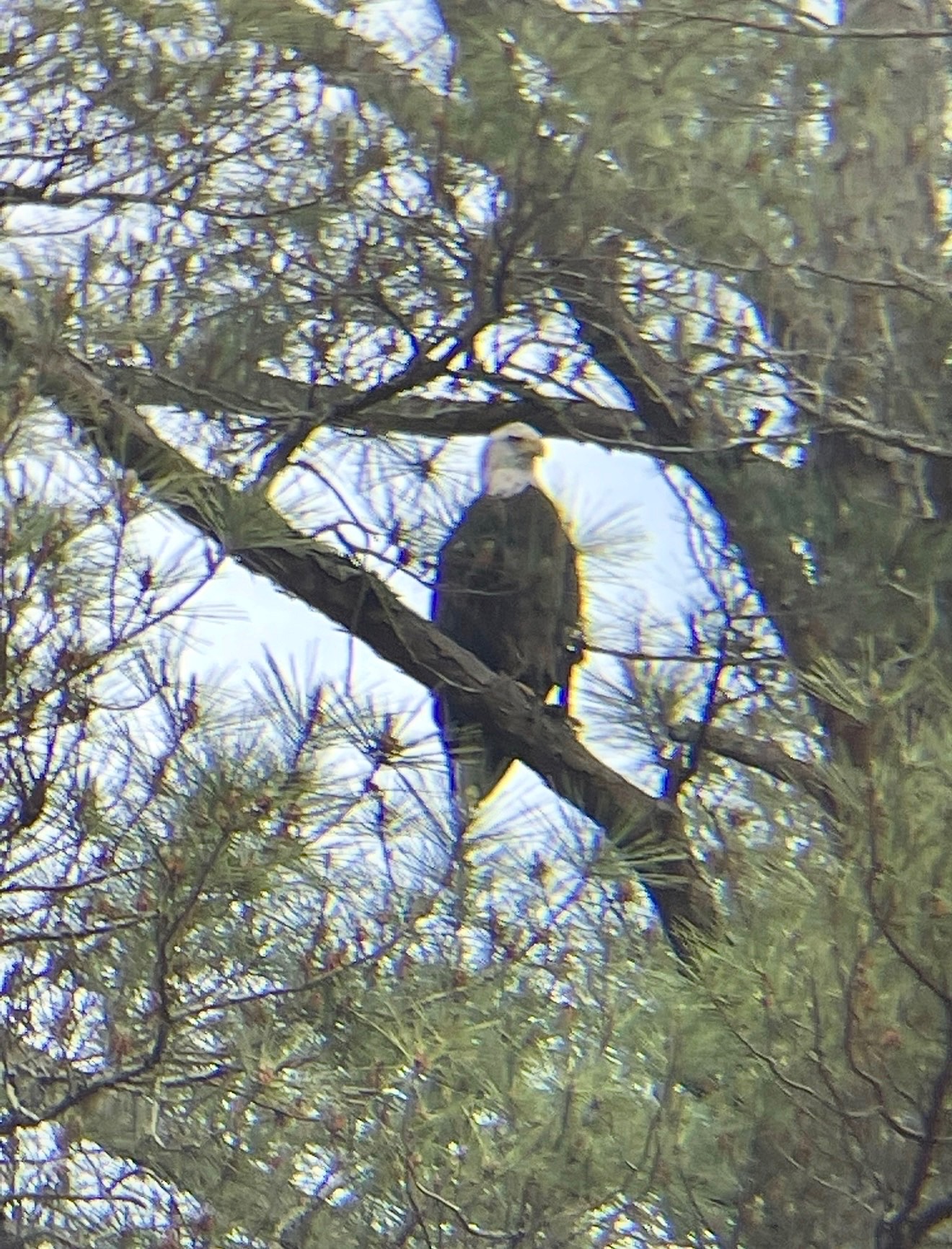
Oglethorpe County is home to a wide range of wildlife, including America’s national symbol. With its brilliant white head and large wingspan, the bald eagle has become a common sight in the county.
Natalie Thier, who lives on Long Branch Lane near Beaverdam Road, said she’s noticed bald eagles on her property since 2022, with the most recent sighting last summer.
“It was sort of one of those moments where I'm like, is that really what I'm seeing,” Thier said.
Her first sighting four years ago happened when she was feeding her chickens. She said she noticed a massive bird perched at the top of a tree.
“We were just amazed, like absolutely in awe of it, because it was so big, and just to see one in person here,” she said.
Many residents have noticed the birds flying over the county, including near Stephens, Sandy Cross, Veribest and Hawk’s Landing, among other locations, according to the responses from a question posted on The Oglethorpe Echo’s Facebook account.
Lisa K. Sears Nation, who lives in Crawford, wrote she saw one on Hargrove Lake Road, just east of Mitchell Farm Road last August. She included a photo she took as it flew away.
Lexington’s Winn Brown said he saw one in action on his property.
“The first time we saw it, it was like, “Wow,’ ” Brown said. “We were kind of in awe that we had an eagle on our property.”
However, bald eagles weren’t always a common sight in Georgia, or in the United States.
In the late 1950s, the Georgia population of bald eagles was at an all-time low. According to the Georgia Department of Natural Resources, there was only one successful nest, and the bald eagle was described as a “rare transient.”
An insecticide known as DDT was one of the primary causes of the decline of the population, along with human mistreatment of the species.
“They declined substantially, and by the ’60s and ’70s were almost nonexistent,” said Todd Schneider, a wildlife biologist with the Georgia DNR.
By the ’70s, DDT was outlawed and the federal Endangered Species Act was passed.
Georgia had its own Endangered Wildlife Act, so that rare species — including the bald eagle — could be protected.
In an attempt to recover the species, Georgia DNR released young bald eagles in 1979 as a part of a “hacking program.”
Data from 2024 shows that the eagle nesting population remains strong. The survey stated that there were 145 nest territories, with 116 being successful and fledging 178 eagles.
“It's not uncommon to see these birds. They're coming back to flourishing so well these days,” said Mark Stephens, Georgia Department of Natural Resources game warden.
Rural areas, like Oglethorpe County, are beneficial for the bald eagle population because of their inclination to nest far from civilization.
“It’s got everything an eagle wants, so that versus all the subdivisions in a semi metro or metro county in the state, where the probability of them existing, are rare to none,” Stephens said.
Although the bald eagle population has since grown in Georgia and is no longer considered endangered, seeing the nation’s most symbolic creature still matters.
Schneider said to let the Georgia DNR know of sightings, but most important, nests.
“If you see something that would indicate nesting, carrying large sticks or an actual nest, we’re very interested in that,” he said.