
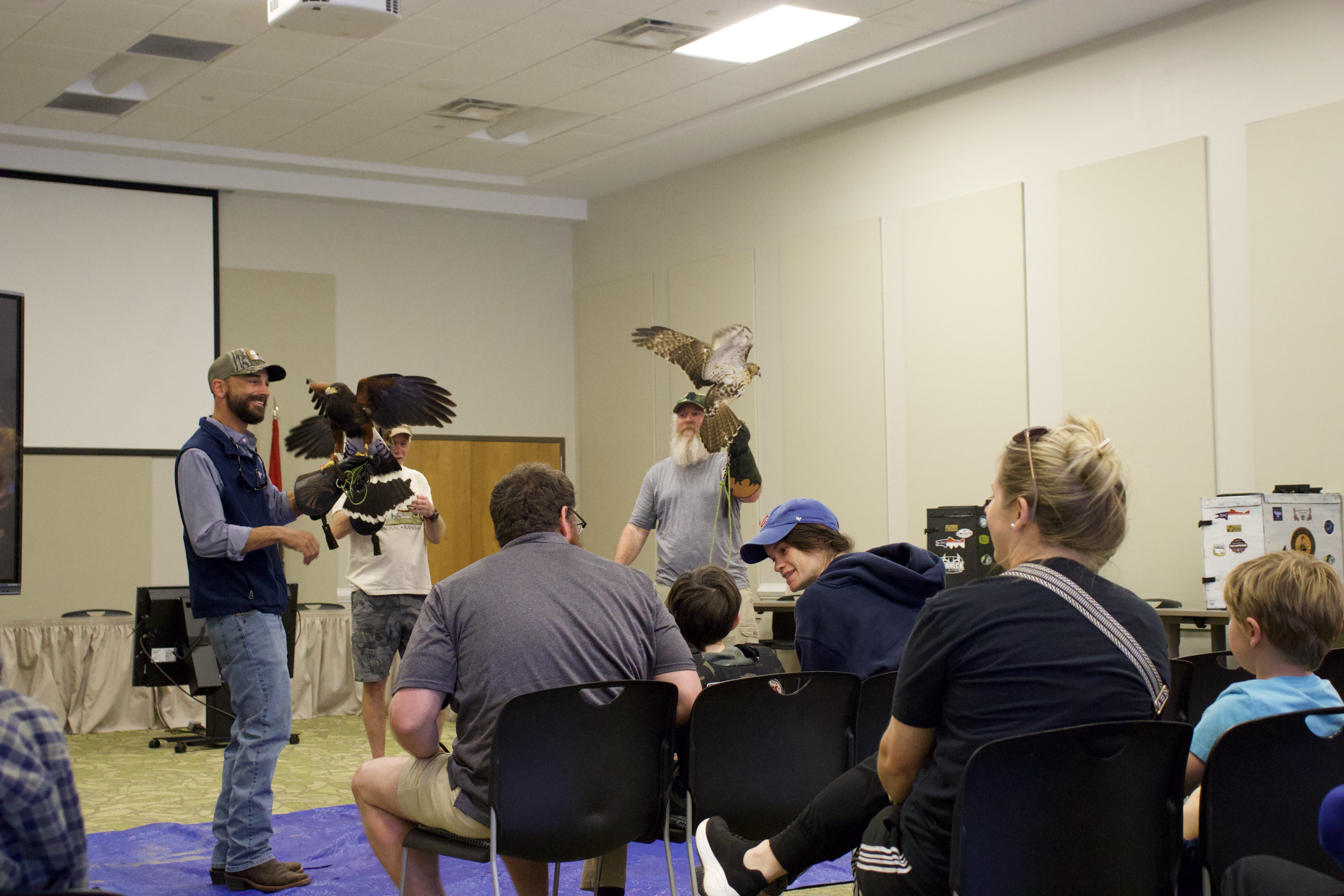
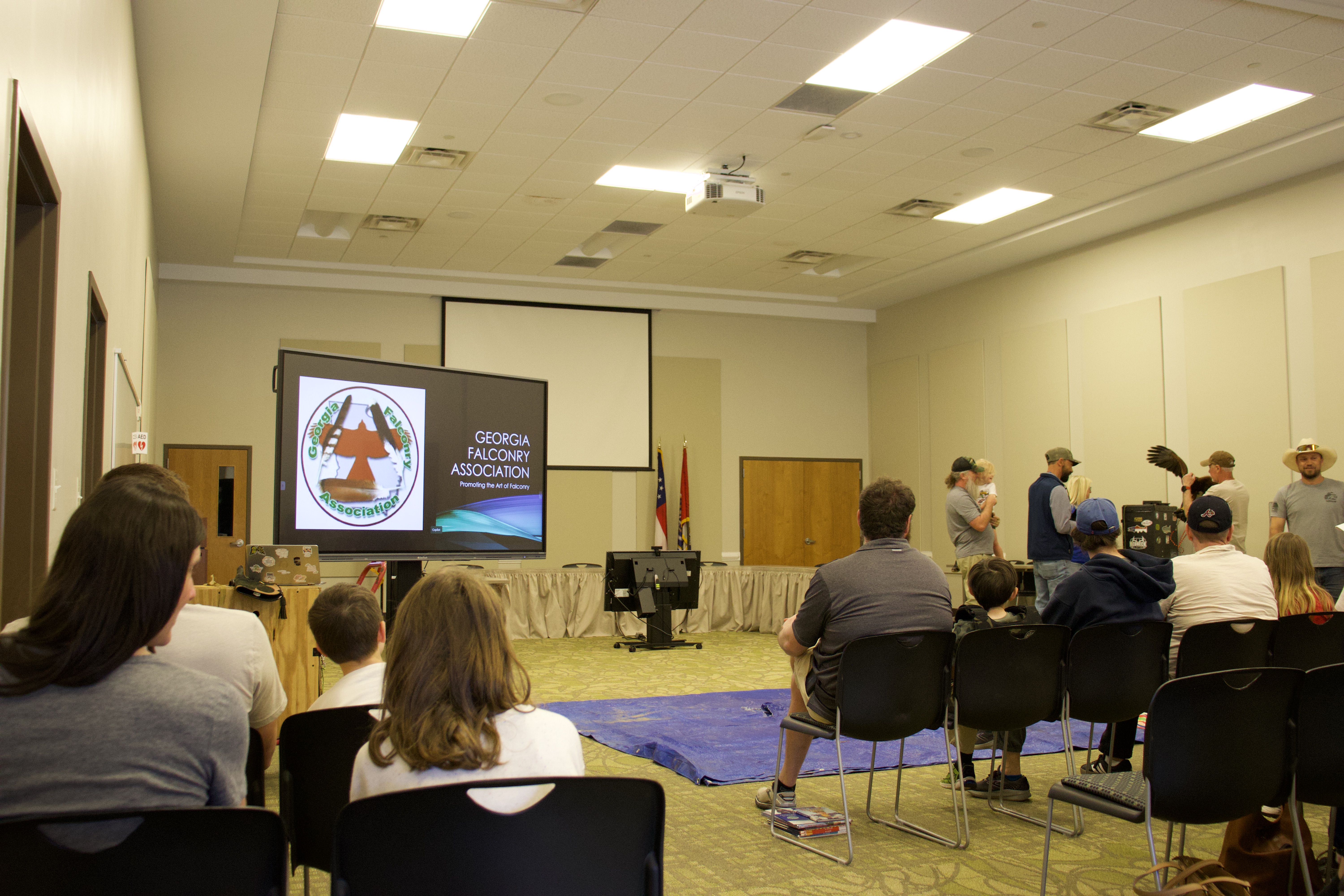
Three falconers stand before a packed room at the Jefferson Public Library.
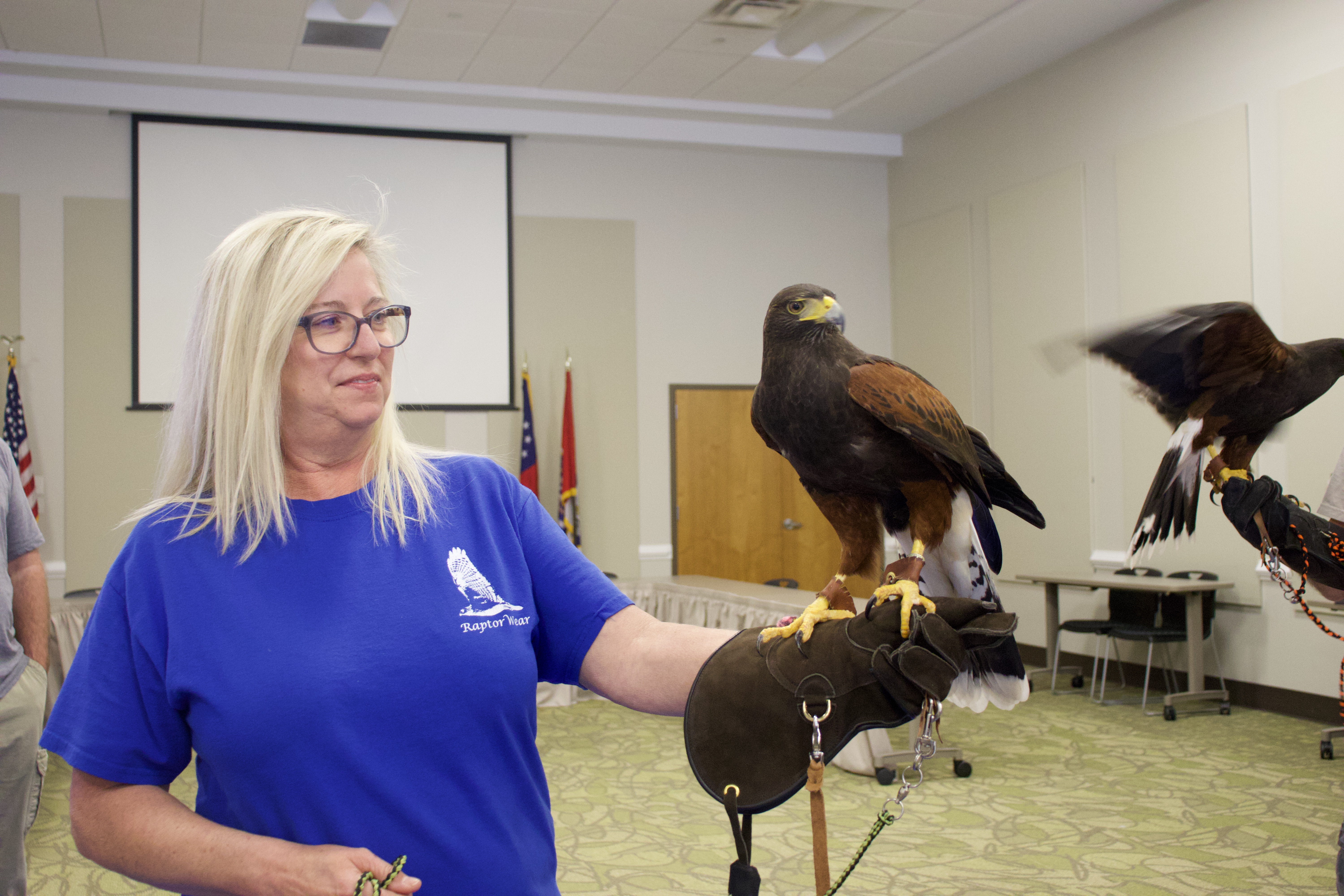
Each has a hawk perched on a thick leather glove, designed to protect them from the weight of the birds alone, enough to pierce their skin without trying.
The handlers remain calm, at ease with the taloned raptors just inches from their faces. The true mark of a master falconer.
But the Harris’s hawk, tethered to Ben Hill’s arm, fidgets noticeably more than the birds held by his fellow Georgia Falconry Association members.
This leads Hill, a falconer from Arnoldsville with a decade of experience, to provide an explanation at the library event that drew nearly 80 attendees on March 22.
The bird isn’t his, but a loan from a friend.
On March 6, strong winds brought down a tree branch onto Hill’s mew, allowing his beloved Red-tailed hawk, Belle, to escape.
A natural predator, she flew into a neighbor’s flock of free-ranging chickens. In an effort to protect his animals, the neighbor killed Belle and returned her to Hill in a bucket.
The presentation was especially difficult for Hill, who had hunted with Belle since 2020, far longer than he would typically keep a raptor, as The Oglethorpe Echo reported in 2022.
“God, she was such a phenomenal bird,” Hill said.
“I could let her fly to a child of your size without even thinking that you would be hurt,” Hill added, gesturing to a small child seated at the front of the presentation. “She was that gentle. So I loved doing presentations with her.”
Despite his 10 years in falconry, Hill said he’s faced doubts since losing Belle.
“But then I thought about how much joy this brings to my life, and I said, I was born to do this. I was born to be a falconer,” Hill said.
He’s found purpose in educating others about the art of falconry and the importance of protecting the birds.
“I can take this information and share it with you people so you guys can have a better understanding of what we do with these animals and how much they mean to us as falconers,” Hill said. “But not only that, how much they mean to Mother Nature alone.”
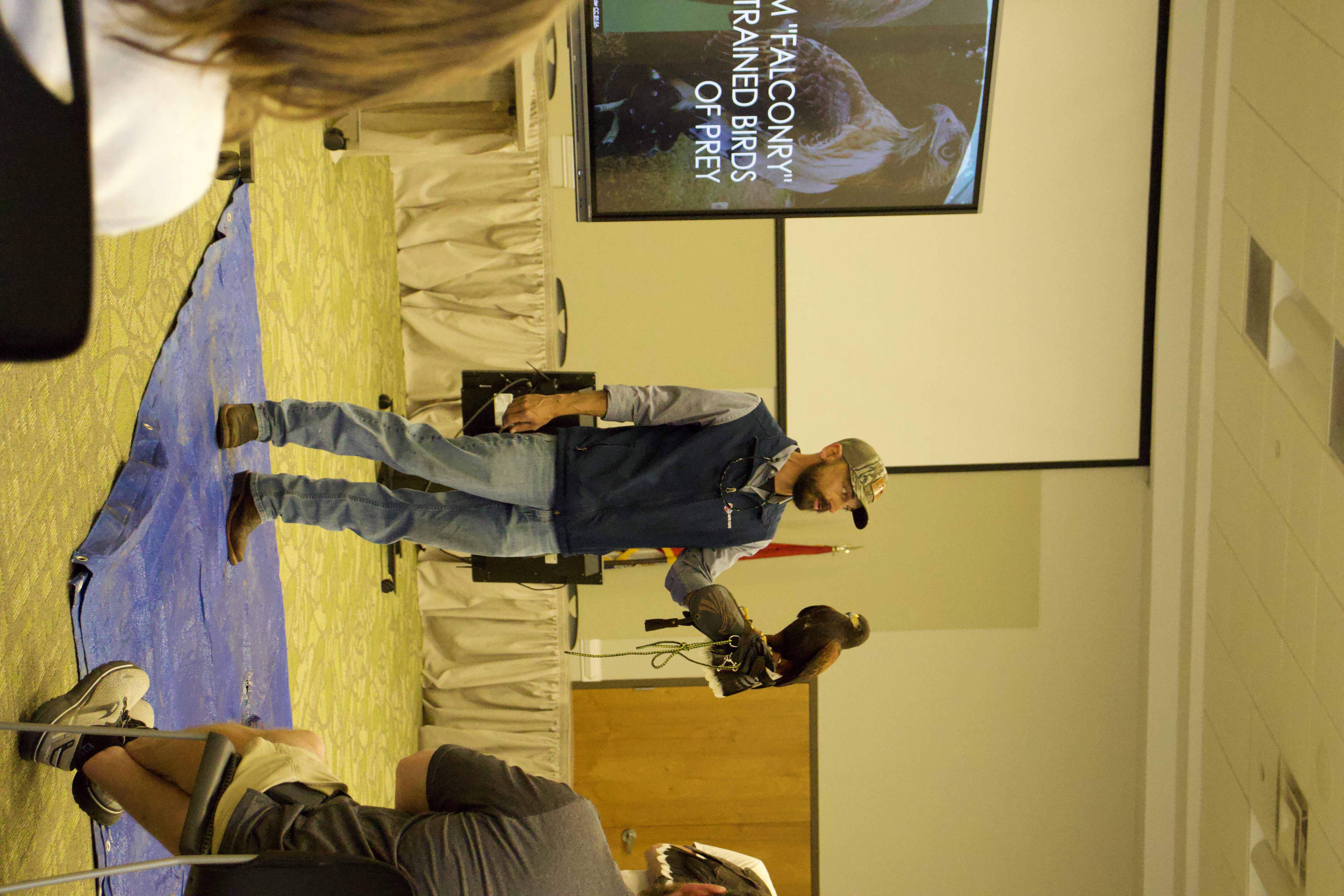
Alongside his sponsor Dennis Blanton, apprentice Joel Bearden and falconer Donna Blanton, Hill discussed the complex path to becoming a falconer, the birds themselves, and — most personally for him — the legal protections for these “noble birds.”
Hill has immersed himself in the legal protections for birds of prey, including the Migratory Bird Treaty Act of 1918, which prohibits harming protected species.
He explained that violations under the 2009 Enforcement Act can result in fines of up to $100,000 and a year in prison.
The presentation was a glimpse into the time and commitment the falconers at the Georgia Falconry Association pour into the sport.
Falconers must pass an extensive U.S. Fish and Wildlife Service exam covering raptor biology, care and regulations.
Then, they complete a two-year apprenticeship under an experienced general or master-level falconer, where their genuine commitment to the sport will be evaluated.
Only after seven years of consistent hunting with raptors can a falconer achieve master status.
“We, as falconers, are the highest regulated sport in America,” Hill said. “You can't just go and buy a falconry permit and go and trap a bird.”