
Oglethorpe County has one stoplight, but Emergency Management Agency director Douglas Spencer is already thinking about what happens when it has “two or three.”
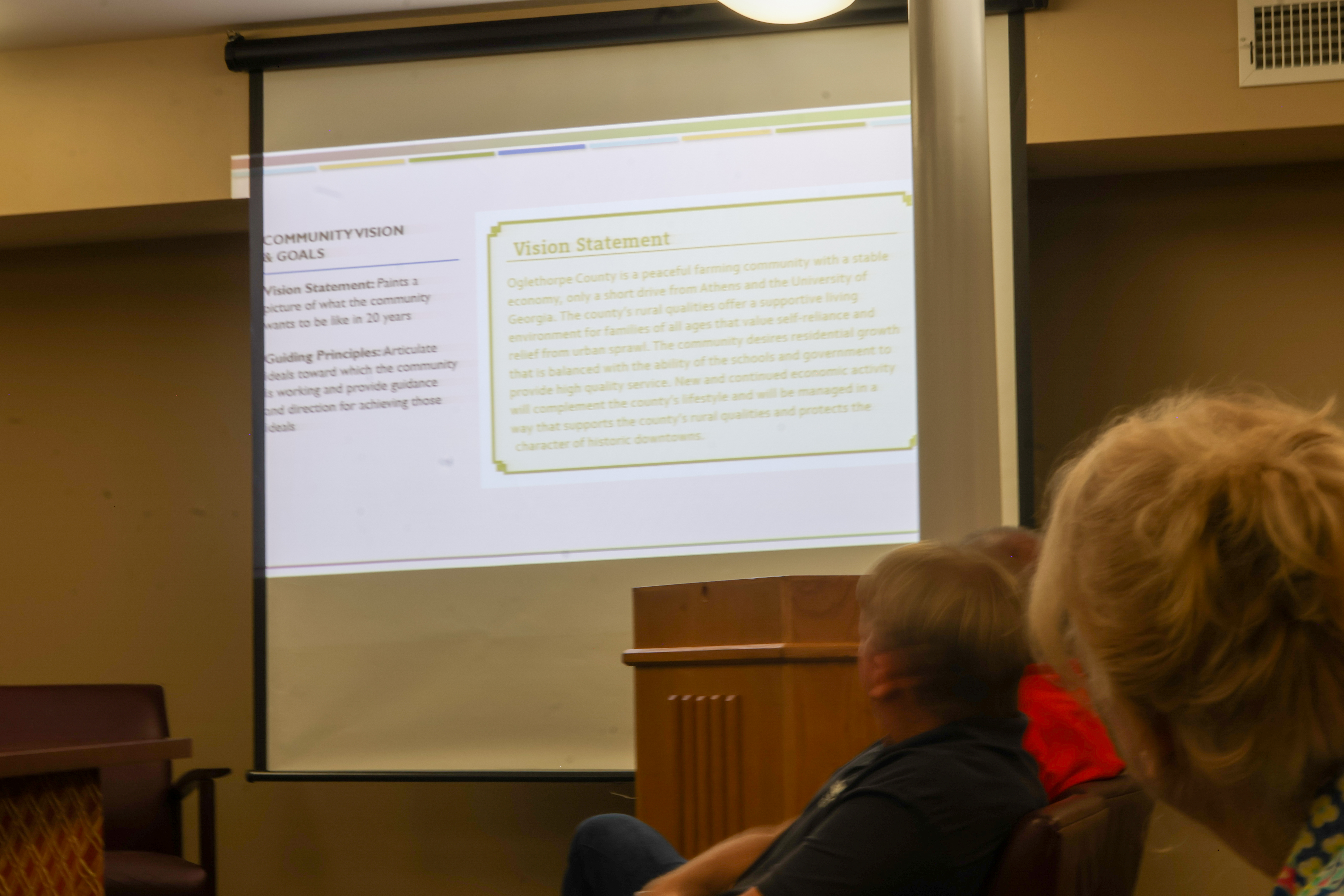
County and city officials are considering the future as they develop the Oglethorpe County Comprehensive Plan Update, which looks ahead at the next 20 years.
Where should new subdivisions go? Which areas should remain rural? And where will public services be needed as more people move here?
The county and the cities of Arnoldsville, Crawford, Lexington and Maxeys are nearing completion of their joint 2026 update after officials held the second and final public hearing in the Board of Commissioners meeting room in Lexington on Monday.
The Northeast Georgia Regional Commission, which has facilitated the planning process, will submit the draft for regional and state review before all five local governments consider adopting it by the Oct. 31 deadline.
Plan breakdown
The Georgia Department of Community Affairs describes comprehensive planning as the process for communities to shape and guide growth and development.
Georgia requires local governments to maintain comprehensive plans, which are updated every five years. For Oglethorpe County, the plan can guide local officials when making decisions about rezoning, land use and public investments.
Those decisions could become increasingly important as the county grows.
The draft projects the county will reach 19,624 residents by 2045, increasing demand for housing, services and infrastructure. Oglethorpe County’s population was estimated at 16,415 residents in July of 2025, according to the U.S. Census Bureau.
According to the draft, public input showed support for preserving farmland and the county's rural character. Residents also raised concerns about subdivision development and its potential effects on property taxes.
“I think everybody in the county wants to preserve as much of our rural heritage as they can, and I think this does a really good job of that,” said Jeff Sharp, director of planning, zoning and compliance.
Sharp and Spencer said the county can direct more intensive development toward areas better equipped to handle it, including the Gateway Corridor along Highway 78.
Growth patterns also matter to emergency services.
Spencer said the plan allows his department to consider how development could affect its operations.
“Where’s the county going to need to put resources to so that you’re not reacting to growth — that you’re controlling growth?” Spencer said.
What are the plans?
While the five governments share a comprehensive plan, each has its own five-year work program identifying priority projects for 2027 through 2031.
Oglethorpe County’s projects include evaluating a countywide water system, expanding water and sewer infrastructure for economic development, preparing for Next Generation 911 and continuing to work on the Firefly Trail.
Arnoldsville plans water system improvements, historic preservation and a city park. Crawford’s projects include downtown improvements, road and water infrastructure improvements and Firefly Trail work.
Lexington’s program emphasizes historic preservation and downtown development, while Maxeys plans improvements to parks, public buildings, roads and its water system.
What happens next?
No resident spoke during the public comment portion of Monday’s final hearing, despite the decisions the plan could help shape.
Monday’s meeting wasn’t residents’ only opportunity to participate.
The planning process included an earlier public hearing, a January open house and a community survey completed by 163 people.
Sharp said officials would have welcomed more public comment Monday.
“We usually get it after the fact,” Sharp said.
For Sharp, planning for Oglethorpe County’s future is not necessarily about encouraging development. It is about deciding where the county can handle growth. Sharp said he believes that area is the Gateway Corridor.
“I don’t know that anybody in this county wants a lot of development,” Sharp said. “But if it comes, we want to force it in here.”