
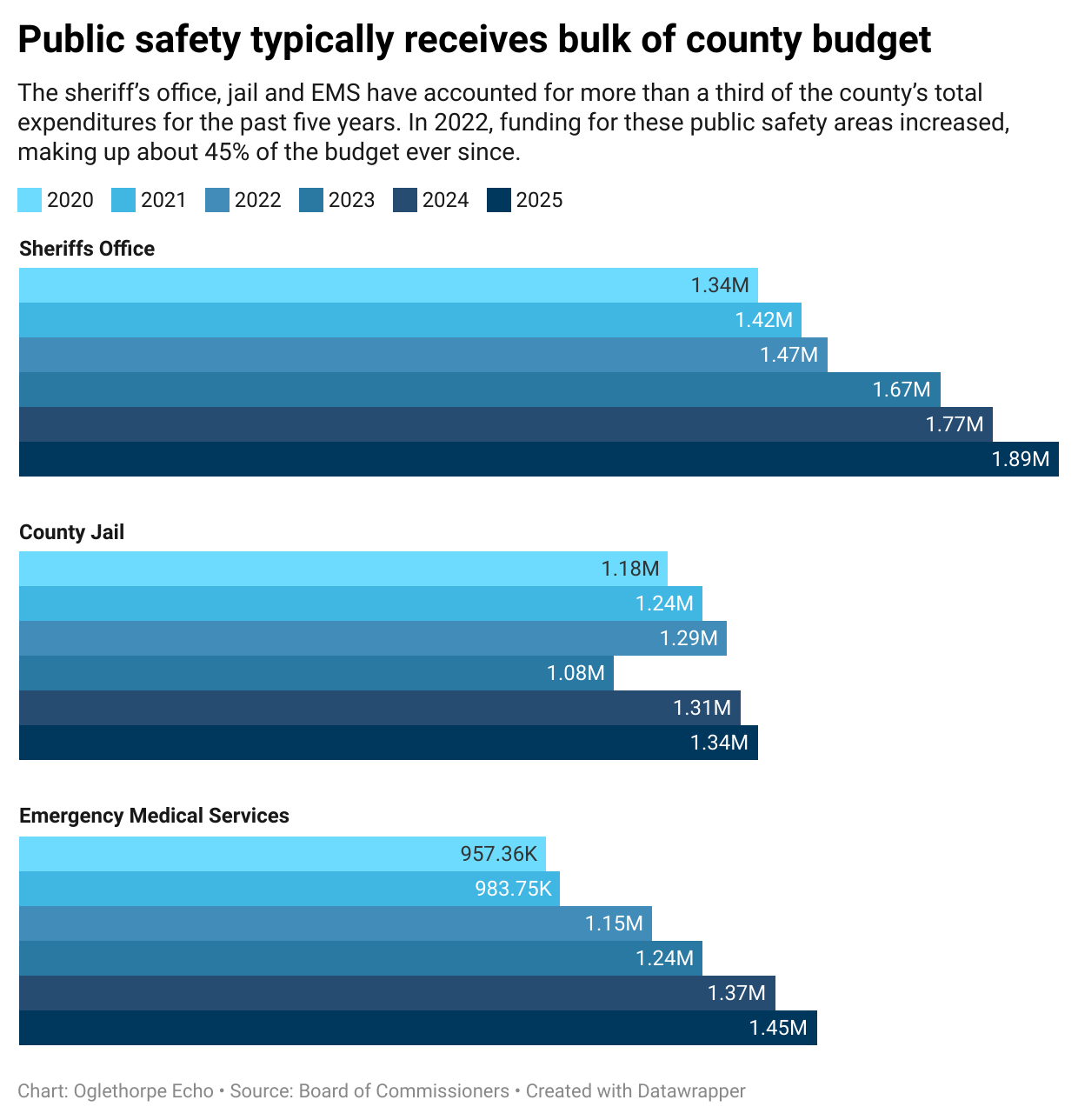
Oglethorpe County usually allocates the majority of its budget to public safety, specifically to the Sheriff's Office, jail and emergency medical services (EMS).
The FY26 budget, which is being finalized and will be on the agenda for the Board of Commissioners at their Oct. 6 meeting (6 p.m.), follows the same pattern.
The 2026 budget is projected to increase about 9% from FY25’s $10.22 million budget, county administrator Jason Lewis said, which would mean approximately $11.14 million.
The commission also plans to move the millage rate to the rollback rate at the meeting, Commission Chair Jay Paul said.
Since 2020, the Sheriff’s Office, jail and EMS have accounted for more than a third of the county’s total expenditures in the annual budget. In 2022, funding for these public safety areas increased, making up 45% of the budget.
“Around 70% of each department’s budget is spent directly on the employee,” Lewis said. “It’s largely influenced by the amount of employees that the department has.”
Public safety tends to get the most money because it has the most employees and is always open. Public works was the fifth-highest funded department in 2025, behind the Sheriff’s Office, EMS, the jail and the commissioner’s office.
“Any of your emergency services, if you think about it, they’re 24/7 (and) 365,” Paul said. “They are gonna get the bulk up from the county level. It makes sense that they’re gonna increase just because they never close.”
 The budget has increased steadily over the past few years, with an overall increase of $2.45 million since 2020.
On the other side of the ledger, property taxes are the largest source of revenue, consistently making up about 38% of the total revenue every year.
Other revenue sources — like local option sales tax, insurance premium tax and title ad valorem — increase annually, which allows the budget to increase.
Lewis predicted that hospital transport fees would go up in 2026 as well.
“There’s a lot of moving parts when it comes to getting all of this finalized for 2026,” he said.
Lewis compiles the budget by meeting with department heads, fulfilling requests and prioritizing needs. The target with the budget every year is to reach the rollback rate, a millage rate that prevents a tax increase by ensuring the county collects the same amount of property tax revenue as the previous year.
Lewis said he makes all of these decisions with the taxpayer in the “forefront” of his mind because all of the budget “comes from tax money of some sort from somewhere.”
“The business of the county changes almost daily,” Lewis said. “The budget process is continuous.”