
When Andy Johnston, soon-to-be editor of The Oglethorpe Echo, got a call from his boss one Friday afternoon in September of 2021, he thought he had done something wrong. But that was, in fact, the last thing on Charles Davis’ mind.
Davis, the dean of Grady College of Journalism and Mass Communication at the University of Georgia, called because he had been presented with a proposition about potentially saving The Oglethorpe Echo. The editor and publisher at the time, Ralph Maxwell, was ready to retire, and there didn’t seem to be interest in anyone taking it over.
The closure of The Oglethorpe Echo would have meant that there would no longer be a local news source for Oglethorpe County. It would become a “news desert.” Dink NeSmith, an Oglethorpe County resident and a friend of Davis and Maxwell, had other ideas.
“I was determined to not live in a community without a newspaper,” NeSmith said. “A good newspaper is a community talking to itself through the pages … and that's what I wanted The Echo to be. It had such a great legacy.”
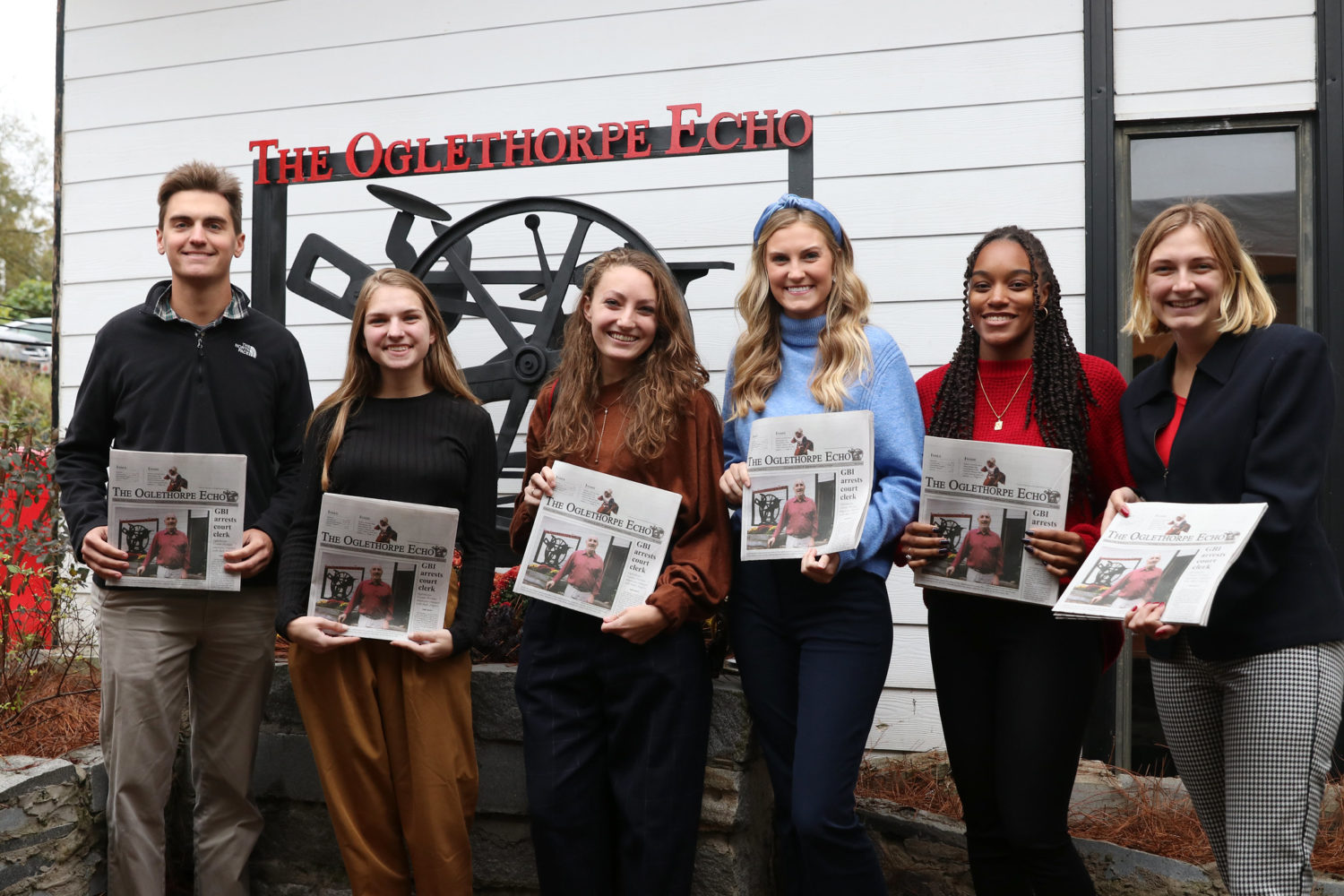
This week’s edition of The Echo marks the one-year anniversary of the first edition published by the partnership between UGA and The Oglethorpe Echo.
“None of this could have happened without the endorsement of Ralph Maxwell and his family,” NeSmith said.“Ralph’s institutional knowledge has been an irreplaceable resource during the transition. I believe this was meant to be — the way everything came together so quickly.”
When NeSmith presented the idea to Davis, he was immediately intrigued. The Echo, which is now 149 years old, had a long and historic legacy that couldn’t be overlooked. Additionally, he was always looking for experiential learning opportunities for journalism students, and taking over a community newspaper seemed like a golden opportunity.
“There's tremendous benefit in covering a community where you are not anonymous, where people know who you are, where you have to be directly accountable to your sources because you’re gonna see them the next time you’re there,” Davis said.
So came the idea of Grady journalism students becoming the editorial staff of The Echo — but they were going to need help.
Davis looped in Johnston, an instructor at Grady College, and eventually Amanda Bright, another Grady professor, came on board.
Then it was time to figure out the nuts and bolts: how were they actually going to save this paper?
The answer was obvious: they needed journalists. Johnston hired seven interns to start reporting for The Echo that October. They were excited to get real-life reporting experience, but also had reservations about whether or not they’d be able to pull it off.
“I wasn't sure if we'd get too overwhelmed and wouldn't be able to fulfill our obligations to the public and give them the news that they needed,” said Thomas Ehlers, one of the first student reporters for The Echo, who has since graduated.
Johnston described the first paper they came up with as “rushed” — but he and Bright knew what they needed to do to put the paper together after being in the newspaper industry for decades. No matter what happened, the paper would come out.
One year later, The Oglethorpe Echo has published a paper every week without fail, and has launched digital products in the form of social media platforms, a website and an email newsletter.
“We want The Echo to feel familiar and comfortable, and it says the things that The Echo should say,” Bright said. “But we also want to innovate — both for the future of local news, but also for our students' experience and learning.”
Working for The Echo has left significant impacts on its student reporters. Senior Alden Lisse covered features when she joined last October, and it made her fall in love with community journalism. So much so, in fact, that she plans to pursue it after graduation.
“News really is so important everywhere to everyone,” Lisse said. “It was really cool on my end to see that my job affected people, but it was also cool to realize that I was making a difference in (Oglethorpe County) because if they didn't have that coverage, where would they get it from? They didn't have it anywhere else.”
For many of the students, the most rewarding part of the process has been seeing the impact the new and improved Echo has had on the community — how its affected residents and made a difference in their everyday lives.
NeSmith said it’s typical to have people come up to him while he’s out and about to compliment the paper. Johnston said he’s received more positive feedback about The Echo in the past year than he had in his previous three decades in print and online media.
“It's so nice to hear from all the people in the community that they're enjoying (the paper), that they read our stories, that they feel heard and seen. That's really special,” said De Turner, a senior and sports reporter for The Echo both last fall and this fall. “I feel like a lot more voices are being heard now that we've taken it over.”
A year later, the paper and its reach has only improved and expanded. Still, Johnston said he doesn’t see himself becoming comfortable anytime soon.
“We'll never be complacent,” Johnston said. “We'll never say we've accomplished everything that there is to accomplish because I don't think we will ever get to that point. It's not a bad thing. It's going to always challenge us to be better, to put new things in place.”