
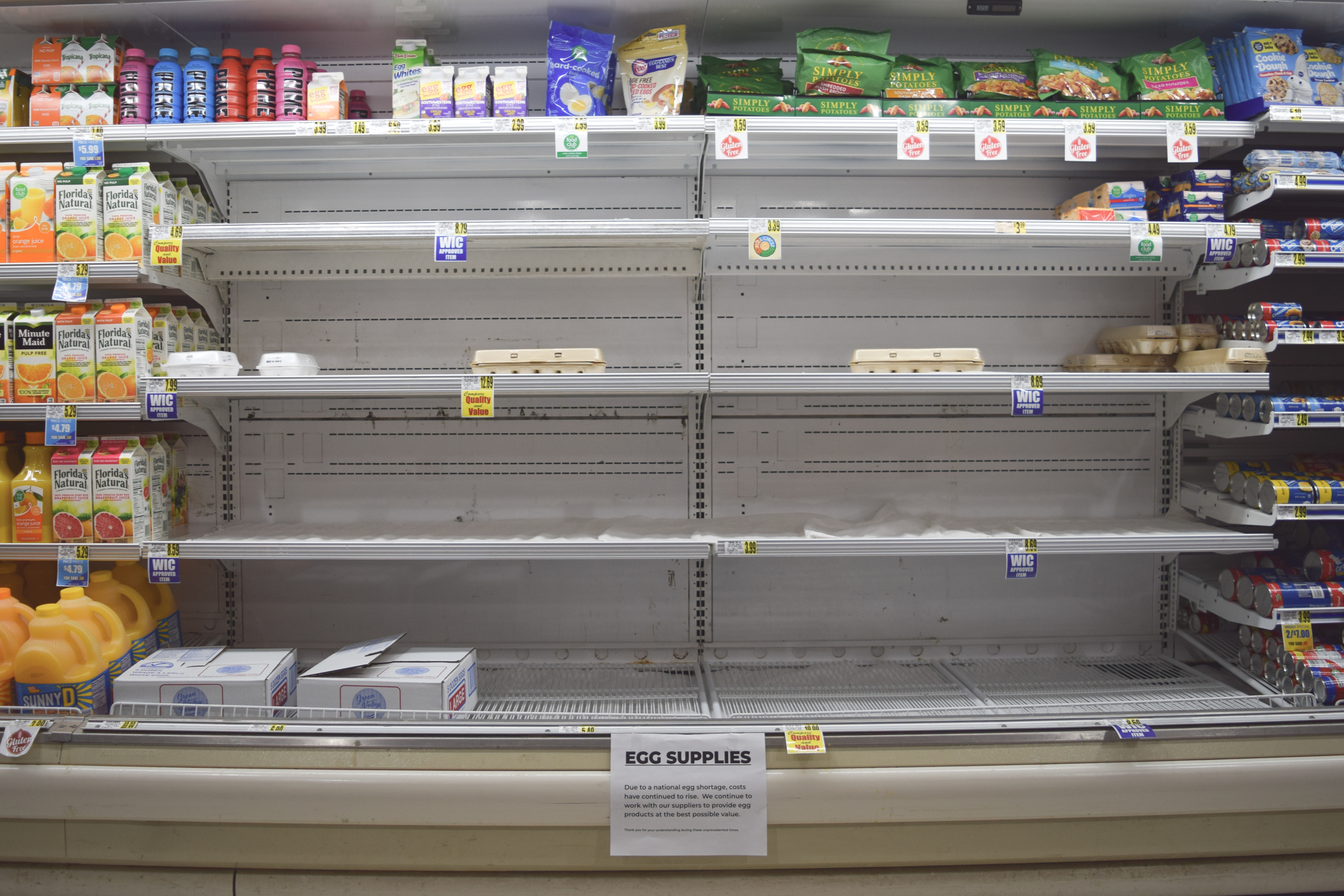
The egg section in B&T’s Food Fresh Market in Lexington sits nearly empty this week.
Manager Tammy Watkins has found the egg shortage and the rising prices of eggs to be “frustrating.” The store would sell up to 80 dozen daily on average, but now, it sells approximately 30 dozen.
“There’s not enough (for B&T’s) to buy,” Watkins said. “They’re out of stock.”
Watkins said the distributing company the store uses — Merchant Distributors Incorporated — has offered little to no explanation. It sent a flier to hang in the egg section explaining the presence of an egg shortage.
According to a report by the U.S. Department of Agriculture, the outbreak of avian influenza, bird flu, in eight states has resulted in the loss of 23.5 million birds nationwide, single-handedly impacting the price of eggs.
The report said the price of national, loose eggs has increased by 5%, with the processed share of weekly shell egg production has decreased by 0.4%.
Because of the shortage, B&T’s increased its egg prices from $3 to $8 a dozen. Watkins said customers have been “shocked at the price,” and she has seen an uptick in people turning to backyard growers.
One of those backyard growers is Rowdy Rooster co-owner Kathleen deMarrais, who said that her regular customers “depend” on her for eggs.
DeMarrais owns 40 laying hens and produces up to 150 eggs per week for her own food, as well as at the Rowdy Rooster. She said the price of chicken feed also has gone up, forcing her to increase the price of her food at Rowdy Rooster.
“I don’t know what the costs are for these big farmers that produce commercially, but I would imagine if the price of seeds (has) gone up for us, it’s going to go up for everybody,” deMarrais said.
She said she is happy they “have their own” eggs with the sudden increase in egg prices.
“We’re a little shop, and we want the local people to come,” deMarrais said. “We try real hard not to have really high prices that would put people out of being able to come here.”
With the national egg shortage impacting Oglethorpe County, Jaimie Still saw an opportunity to sell her eggs at the competitive price of $4 a dozen. Still owns 40 chickens at J. Still Farm in Arnoldsville, producing up to 10 eggs per day.
“(Selling the eggs) helps the community, especially with the shortage right now,” Still said. “We want to help people, but also try and make back enough to keep feeding them all, so we can keep helping others and produce quality birds.”
Still believes people will start to raise their own chickens in rural areas such as Oglethorpe County to combat the shortage of eggs and the rising prices, which may affect her business.
“If there’s an overpopulated area that everybody has chickens, then nobody’s going to want to buy chickens from us,” Still said.
Watkins said she hopes that B&T’s can “get eggs and the price comes down.”