
For Travis Legg, farming isn’t just a profession, it’s a legacy.
Legg is a third-generation farmer who lives in Smithonia, where he has been producing cattle, poultry and hay since 1995, but he was introduced to the industry by his grandfather and dad.
Now, at 54, he has two sons, Cody and Braxton, who have entered the family business.
Stories like Legg’s, however, aren’t always typical.
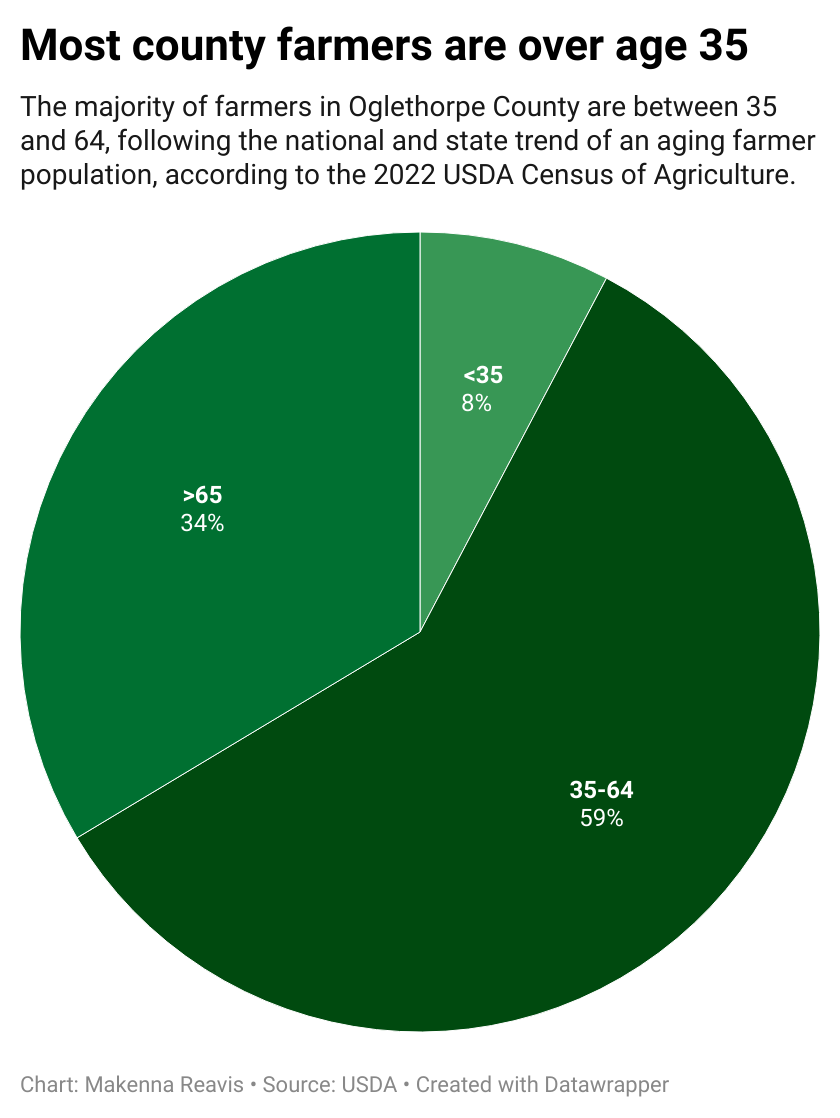
Nationally, the U.S. farm producer population is aging. The 2022 Census reported an average age of 58.1 for farmers, up 0.6 years from the 2017 census.
At the same time, few beginning farmers are entering the scene. Only 30% of farmers in Oglethorpe County are beginning farmers, with 10 or less years of experience, and only 8% are under the age of 35.
In Oglethorpe County, where farming is a predominant part of the economy and produces 3% of the state’s agriculture sales, supporting the farming population is crucial. A shrinking farmer population means less food to support the community.
“As far as just future food insecurities, if we don’t have people replacing those kind of aging out, that would be a threat to any industry,” said Shanna Reynolds, Oglethorpe County Extension agent.
Because of this, building interest in farming in the younger generation — in order to build up the farm population — is a key goal of Reynolds and the extension service.
“One of my plans of work for the county is agricultural awareness through youth livestock programs, because we want to make sure those kids get involved,” she said.
Even if they don’t become farmers or cattle ranchers, Reynolds aims to introduce students to the variety of employment opportunities around the agriculture industry. She said the county’s thriving 4-H and FFA livestock programs show a building interest from the younger generation in getting involved.
Even when there’s interest though, the biggest barrier to young or beginning individuals becoming farmers is the lack of available land or the high cost of land.
“If you don’t already own farmland, it’s hard to obtain,” Reynolds said. “It’s getting more and more pricey in our area.”
Since 2020, farmland prices have been climbing, rising over $1,000 per acre, according to the USDA economic research service.
And, as the farmer population ages, experienced farmers continue holding onto their land. This combination creates a challenge for young people who don’t inherit farms or family land.
Legg said these challenges are making it especially difficult for newcomers to break into the industry.
“Mainly, it is the price of the land and equipment right now,” Legg said, “I can’t see anyone being able to just purchase land … the income that it would take to pay farming costs, as well as cattle and equipment costs.”
Legg operates a diverse farm, but even with experience, he said the economics of farming is daunting. The challenges that face all farmers in Oglethorpe County can be seen at a national level.
Despite these difficulties, Legg remains committed to the lifestyle.
“I am a third-generation farmer,” he said. “My grandad and dad farmed. Two of my boys farm now. I love it. I wouldn’t want to be doing anything else.”