
During the day, Chuck Palmer teaches social studies at Oglethorpe County Middle School. But Tuesday and Thursday nights, Palmer catches up with students at the Oglethorpe Foothills site.
“I’d call it a hidden gem,” said Palmer, a site director at Oglethorpe Foothills.
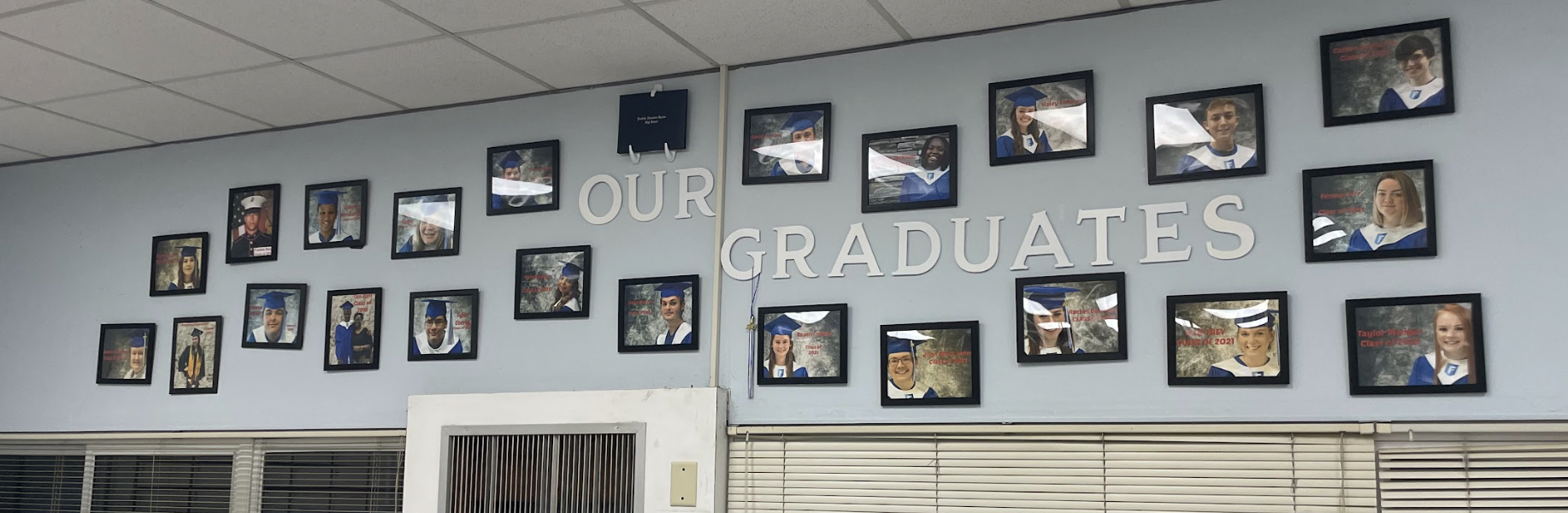
Foothills Regional High School is an accredited public high school aimed at students at-risk of dropping out of a traditional high school. More than 60 students have graduated from Oglethorpe Foothills since it opened in 2018.
“For some reason, having to get a job to help family with bills, having a child at a young age and having to stay home to take care of their child, illnesses that set them back — the day school setting does not really meet what they need,” Palmer said. “Foothills provides opportunity for them based on the belief that all of those things happen. That doesn't mean you naturally forfeit your right to a diploma.”
The Oglethorpe Foothills site, located at Oglethorpe County High School, is one of 16 Foothills Regional High School sites across Northeast and Middle Georgia.
“Many of the students that make it down here are the exact opposite of what people want to envision — being troubled kids or problem youth,” Palmer said. “They're actually very, very bright and talented kids that have a plan, know where they want to go, and the day school process actually hinders them.”
Individualized plan
Unlike a traditional high school, Foothills students move through class content at their own pace. The instructional content is provided through an online platform with in-person, classroom teachers available from 4:30-8:30 p.m. four nights a week to provide help and proctor exams when students are ready to move to the next unit.
Foothills also has a smaller student-to-teacher ratio than a conventional high school. At the Oglethorpe County site, Palmer estimates the ratio is one teacher to 8-10 students, depending on attendance any given night.
Donna Gast, who teaches science at the Oglethorpe Foothills, is a retired Oconee County Middle School teacher, where she taught over 150 students a year.
“A full-time day school teacher does not have that time to spend with the student and work with them to help them learn how to learn — you just don’t have the time,” she said.
Gast said she believes individualized attention by Foothills teachers helps retain students who would fall through the cracks at day school. This specialized attention not only supports their futures, but also supports the communities they live in.
“Instead of having a dropout, you’re getting people who are having diplomas, can get better paying jobs,” Gast said. “They’re not going to be draining financial resources for your county.”
Workers with high school diplomas earn $212 more in median weekly income than workers without high school diplomas, according to 2024 data from the Bureau of Labor Statistics.
Additionally, each student at Foothills is assigned a mentor who reaches out to the student weekly and can advocate to teachers on a student’s behalf.
“The mentor is designed to be that one constant face and one constant voice that is always in touch with that student — that kind of bridge between the student and the classroom,” Palmer said.
These mentors — like over 90% of Foothills’ staff, according to a 2019 report by Foothills — are part-time, often working full-time in other school systems.
Oglethorpe County’s Foothills site has five mentors.
Renee McCannon, the mentor coordinator and REACH scholarship coordinator for Madison County Schools, is the Oglethorpe County site’s newest mentor. Since starting in August, McCannon has already seen one of her mentees graduate Foothills.
“It’s a sweet group of kids, and they’re fortunate that they have this platform, this type of opportunity to get a diploma,” McCannon said.
Claire O’Dillon is a program senior who entered the Oglethorpe Foothills site in August. With one class to finish until graduation, she has started completing dual enrollment courses at Athens Tech, where she plans to pursue a nursing program.
“I’ve matured so much since I started,” O’Dillon said.
Funding issues
McCannon sees the Oglethorpe Foothills site as “the opportunity that’s sitting in the backdoor of the high school.” The challenge is making sure students are aware of the opportunity.
In the site’s first year, the school had just 10 students, Palmer said. Before the pandemic, it had about 120 students. Now, there are about 50 students.
Palmer said he believes the reason Foothill’s enrollment hasn’t returned to pre-pandemic enrollment is due in part to a 2023 change in state legislation.
In 2023, the state legislature passed the Completion Special Schools Act. The act, which went into effect in July 2023, reclassified Foothills — and two other schools like it, Mountain Education and Coastal Plains — from a charter school to a completion school.
“It absolutely changes the manner in which students have an avenue to Foothills,” Palmer said. “But, it didn’t, of course, change the need, and it didn't change the cooperation that we have with the day school in trying to take care and provide students the opportunity to get their diplomas.”
Foothills’ reclassification has limited who can be enrolled. As a result, it reduced Foothills’ funding, which is tied to enrollment.
Previously, students over 16 could apply to enroll in Foothills. Students between 14 and 15 would be evaluated by a special board to determine they have the maturity to succeed in the program.
Now, only students 18 and older who meet the definition of a dropout can directly enroll in Foothills.
Students under 18 can join Foothills as program students. These students can take classes at Foothills, but they are not enrolled in Foothills — their enrollment stays under their day school.
As a result, these students don’t count toward enrollment numbers used to allocate Foothills’ budget, and these students are funded by their resident school system, not the state.
At the same time, the amount allocated by the state per full-time student has also been reduced. According to the Georgia Department of Education, in 2022 — before the legislative change — Foothills Regional High School was allocated $13,069.98 by the state per full-time student. By 2024, the state funding per student dropped nearly 47% to $6,928.62 per full-time student.
“We’ve definitely seen the reduction because of the change of legislation,” Gast said. “Students are graduating, but we're not getting any replacements.”
At the same time, Foothills has also had to overcome misconceptions about the program because of how different it looks from a traditional high school.
“The idea that there’s a different way that’s equitable is not really processed in a positive manner because it’s foreign,” Palmer said.
Palmer sees these differences between Foothills and conventional high schools as a strength for many of their students, who are motivated to complete school to access better work opportunities. While some conventional high schools have moved away from workforce development programs, Foothills’ design has the flexibility to embrace them.
“At Foothills, across the board, the focus is about the student and realizing that there’s more than enough students that need these opportunities,” Palmer said.