
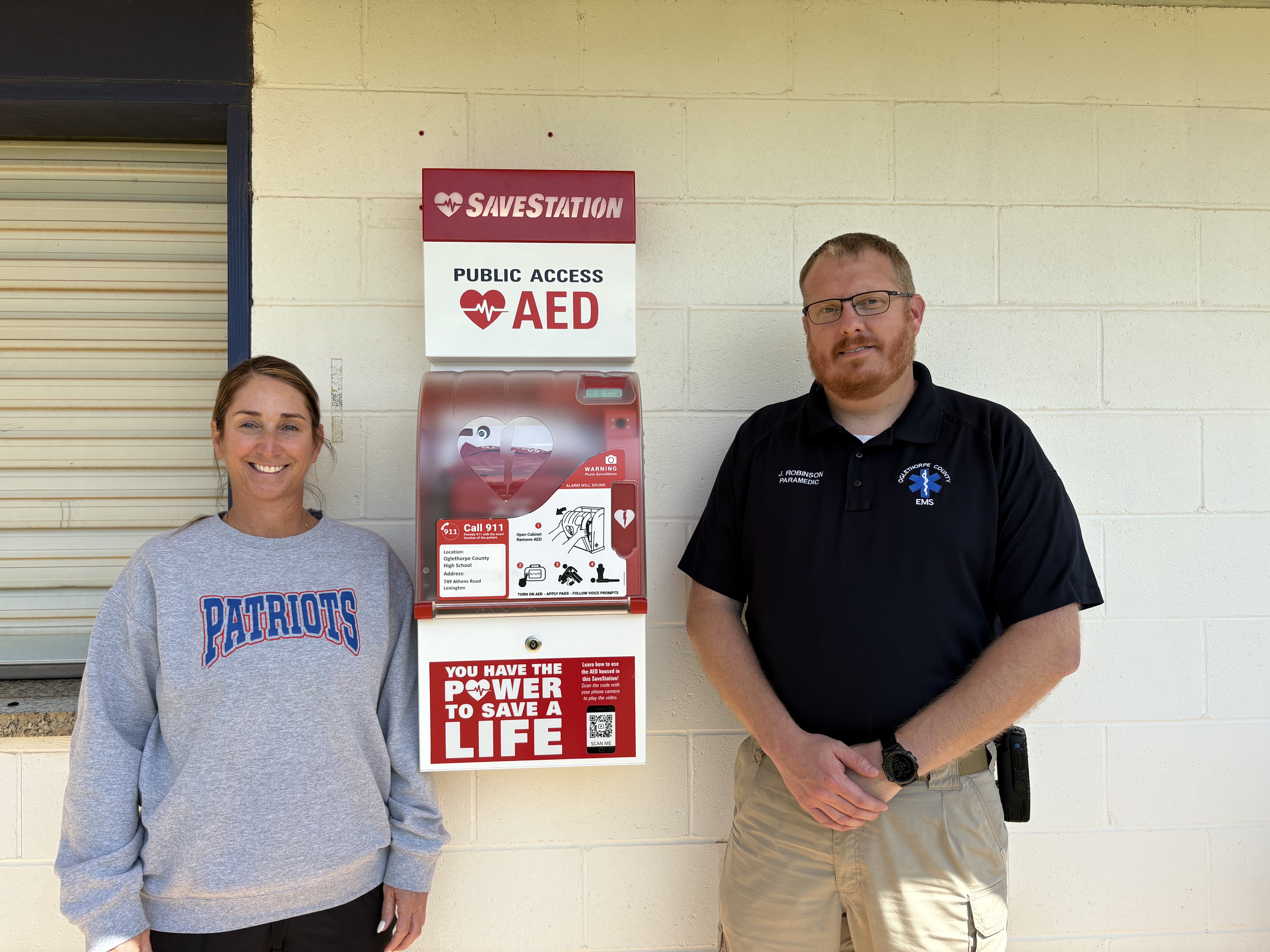
A collaboration between the Oglethorpe County EMS, Sheriff’s Office and school district has helped automated external defibrillators (AEDs) to be placed in various areas around the county.
There are 15 AEDs in county buildings and vehicles, 16 in patrol cars and 18 on school campuses. The idea came from new EMS director Josh Robinson.
“I tried to push that we needed to get some AEDs in the building, and (county administrator) Jason (Lewis) was on board with it. But the issue was the funding for it,” Robinson said. “We had to consider how you find the funding to buy all of these AEDs and keep up with them.”
The funding came from an opioid settlement ($27,018) and a portion of the sheriff’s office budget originally for school zone speed enforcement cameras ($54,468).
AEDs analyze an individual’s heart rate and can deliver an electric shock to restore a normal heart rhythm if someone is experiencing sudden cardiac arrest. Funding from the opioid settlement was able to be used for this project because Narcan — an antidote for opioid overdoses — is in three of the county’s outdoor SaveStations, which are AEDs in climate-controlled boxes.
“Without the school zone enforcement cameras (funding), the majority of this wouldn't be able to be completed because there is only so much of the opioid settlement fund,” Robinson said. “So, we were really excited that the Sheriff's Office was willing to work with us on this project and understood the need and the help AEDs will provide.”
District nurse Kristina Turner worked with Robinson and Chief Deputy Jason Taft to bring SaveStations to the Oglethorpe County High School and Middle School.
“We recognized in our partnership with EMS that we had holes in our coverage, and that if there were a cardiac emergency on campus, retrieving an AED in a quick enough amount of time to make clinical difference was a hole in our safety plan,” Turner said. “So, adding the additional AEDs in these strategic locations gives us the ability to respond to a cardiac emergency quickly and efficiently.”
Turner said AEDs are “simple and user friendly,” as the device speaks to the user, telling them step by step how to properly use the AED.
Given their ease of use, students are not being trained on how to use the devices, but are made aware of the locations throughout the school.
However, there is a group of 10 individuals who are part of an OCHS and OCMS cardiac emergency response team and are trained on how to use AEDs and CPR.
Eventually, the elementary school also will have a cardiac emergency response team of trained individuals.
“Ideally, we would love everybody in the district to know how to use them,” Turner said. “I did a hands-only CPR class (which) showed how to use the AED, as well. This is something teachers get at the beginning of the year and all the coaches get specifically related to their sport.”
Turner said the need for AEDs on campus is backed by research because the No. 1 cause of death on school campuses is student-athletes having cardiac emergencies.
“One thing that people don’t recognize is that cardiac emergencies on school campuses can be deadly, and just because we haven’t had one here doesn't mean that we don’t want to prepare and take the right steps to be prepared to respond in the event that something like that happens.”