
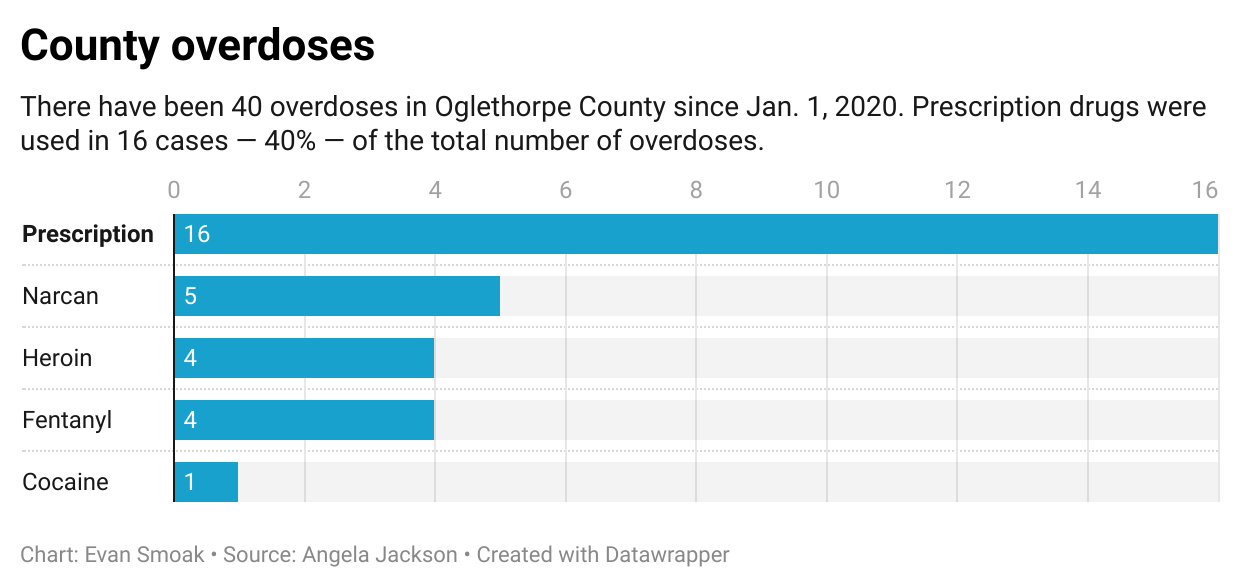
Oglethorpe County is experiencing an increase in drug overdoses.
Angela Jackson, 911 director, said there have been 40 overdoses since Jan. 1, 2020 with 16 a result of prescription drugs.
“I would caution anyone who is buying drugs illegally,” Sheriff David Gabriel said.
Also, data from the Georgia Department of Public Health showed a 75% increase in EMS overdose trips in Oglethorpe County from last July to September, while the rest of the state’s EMS overdose trips decreased by 4.4% during that time frame.
EMS Director Jason Lewis said there’s been a noticeable increase in the number of calls his department has received since August, but it’s important to remember that Oglethorpe County’s sample size for overdoses is smaller than surrounding counties, which means a few individuals can significantly sway the numbers.
Lewis added that a variety of factors — from poverty to the lack of treatment options in the county — contribute to the issue.
“I think there's a lot of barriers our rural community has that our urban neighbors don't have,” Lewis said. “I'm not saying they don't have their own issues, but generally when we're trying to get somebody hooked up with treatment for drugs or alcohol, it’s not in the county, it’s somewhere else.”
There are few medical options within the county, so Lewis said when it comes to mental health, individuals are usually referred elsewhere.
“And if they're referred to an adjacent community, in say Athens, then a lot of folks in our community with these issues also have limited means or no insurance, or are underinsured or without transportation,” he said. “It's a concert of things that there's no one simple fix for.”
Lewis said overdose victims in Oglethorpe County are predominantly 25 to 55 years old. The most common drugs causing overdoses include fentanyl, methamphetamines and opioids. That includes prescription pain medicine like OxyContin, which Lewis said continues to contribute to overdoses in the county.
He said EMS and the Sheriff's Office have seen the emergence of a drug called xylazine in overdoses. The animal tranquilizer is being pressed into fentanyl to make it more potent.
“It’s something that’s designed to be given to a 1,000-pound animal,” Lewis said.
He said there’s been a visible impact by drugs on the county, but there’s been improvement in areas, even though fentanyl continues to be a problem.
“We’re not seeing as much methamphetamines as we were, but we’re seeing more fentanyl,” Lewis said. “I would characterize it as evolving, with the drugs of choice falling in and out of favor, but each generation has its separate challenge.”
Jackson said there’s been a decline since the drug bust in late August in which law enforcement officials confiscated 675 grams of cocaine, 1,700 grams of meth, 250 grams of crack, 5-6 pounds of marijuana and thousands of fraudulent pills, including fake Adderall, from a house on Collins Avenue in Lexington.
“We haven’t had any deaths, but still a couple of overdoses,” she said.