
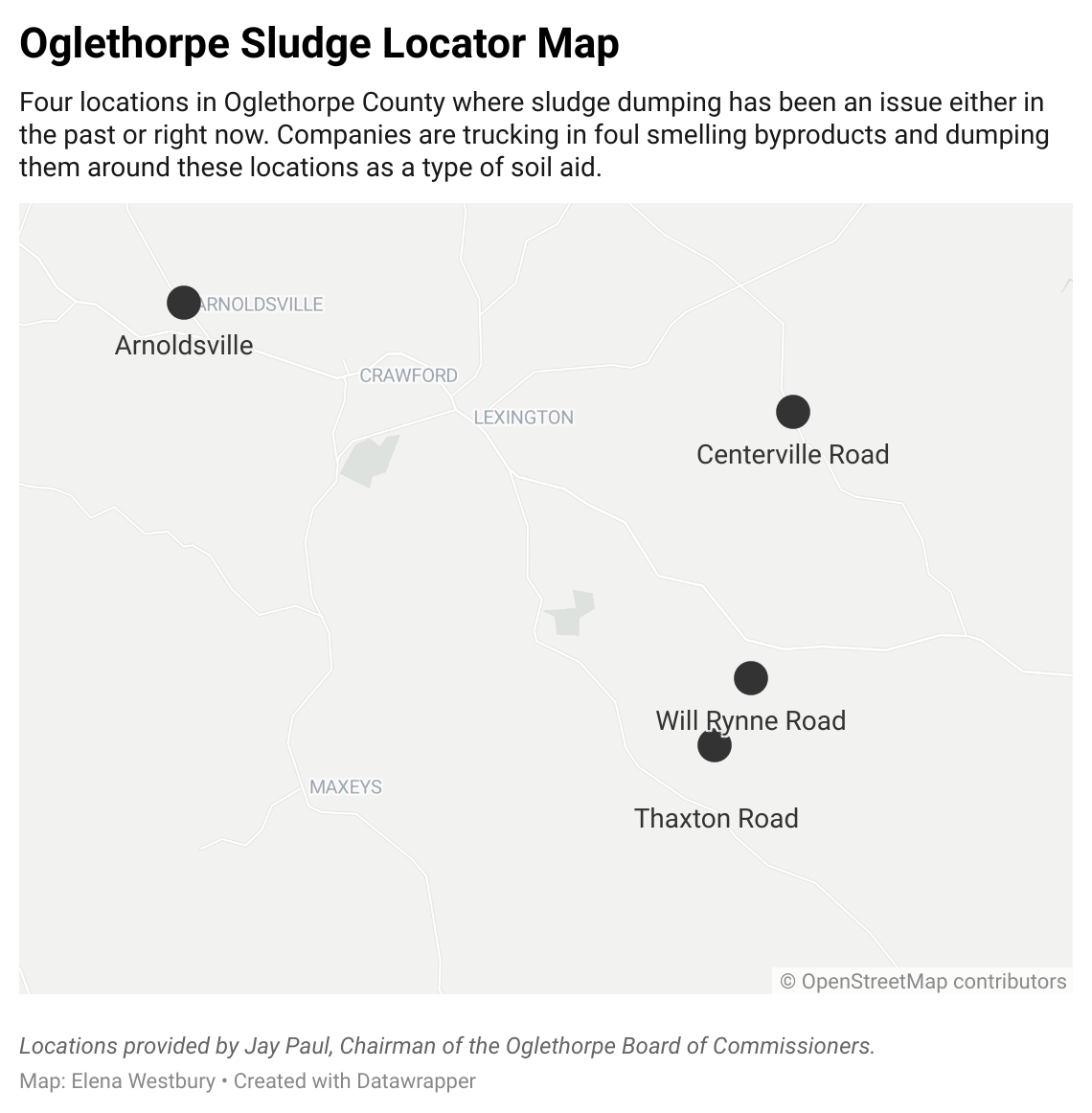
Jay Paul, chairman of the Oglethorpe County Board of Commissioners, will join other county officials for a meeting in Wilkes County next month to try and push for more state regulation of sludge dumping.
Paul and commissioners from Wilkes, Madison, Elbert, Warren and Glascock counties will meet with the Department of Agriculture on Feb. 18 to advocate for more state-level assistance in the regulation of soil amendments.
“If we can’t do it, we’re begging them to,” said Paul.
Residents of Oglethorpe and nearby counties have dealt with foul-smelling chicken byproducts and other unknown substances being dumped on farmland near their homes as a type of soil amendment the past few years.
According to the 2020 Georgia Code, the term “soil amendment” refers to “any substance intended for changing the characteristics of soil or other growth medium.”
Companies can register their industrial byproducts through the Department of Agriculture, and Paul said, as long as it is free of septage, it can usually be classified and qualified as a soil amendment.
In early 2021, state legislators made amendments to the Georgia Code with Senate Bill 260 that expanded on the rules and regulations of soil amendments. One of the changes includes the requirement, “Every owner and operator of a farm on which soil amendments are being applied to (must) procure a site-specific nutrient management plan and make a copy of such plan available for inspection at the request of the department.”
However, with the state legislature’s revised rules and regulations for soil amendments, Paul said the local government’s hands are tied when it comes to being able to properly regulate the application of sludge.
“The counties wanted to adopt more stringent regulations, and then the state overan what we can do,” he said.
Counties are limited to a setback regulation of 100 feet in property lines because of another rule that was passed in Senate Bill 260. This 100-foot buffer limit for the application of sludge is not enough for residents who can smell the pungent odor on their property.
Michelle Lester, of Lexington, discovered through water testing that the consequences of nearby sludge dumping go far beyond its foul stench.
“We found that people who live closest to the farm (with sludge) had higher arsenic levels in their well water compared to those who lived further out, some of it beyond the EPA guidelines,” Lester said.
Lester said soil amendment testing needs to go way beyond what is currently required, and more regulations for sludge dumping need to be implemented by the state to prevent toxic air and water quality in the county.