
Sheriff’s koi hobby helps him relax and provides future path
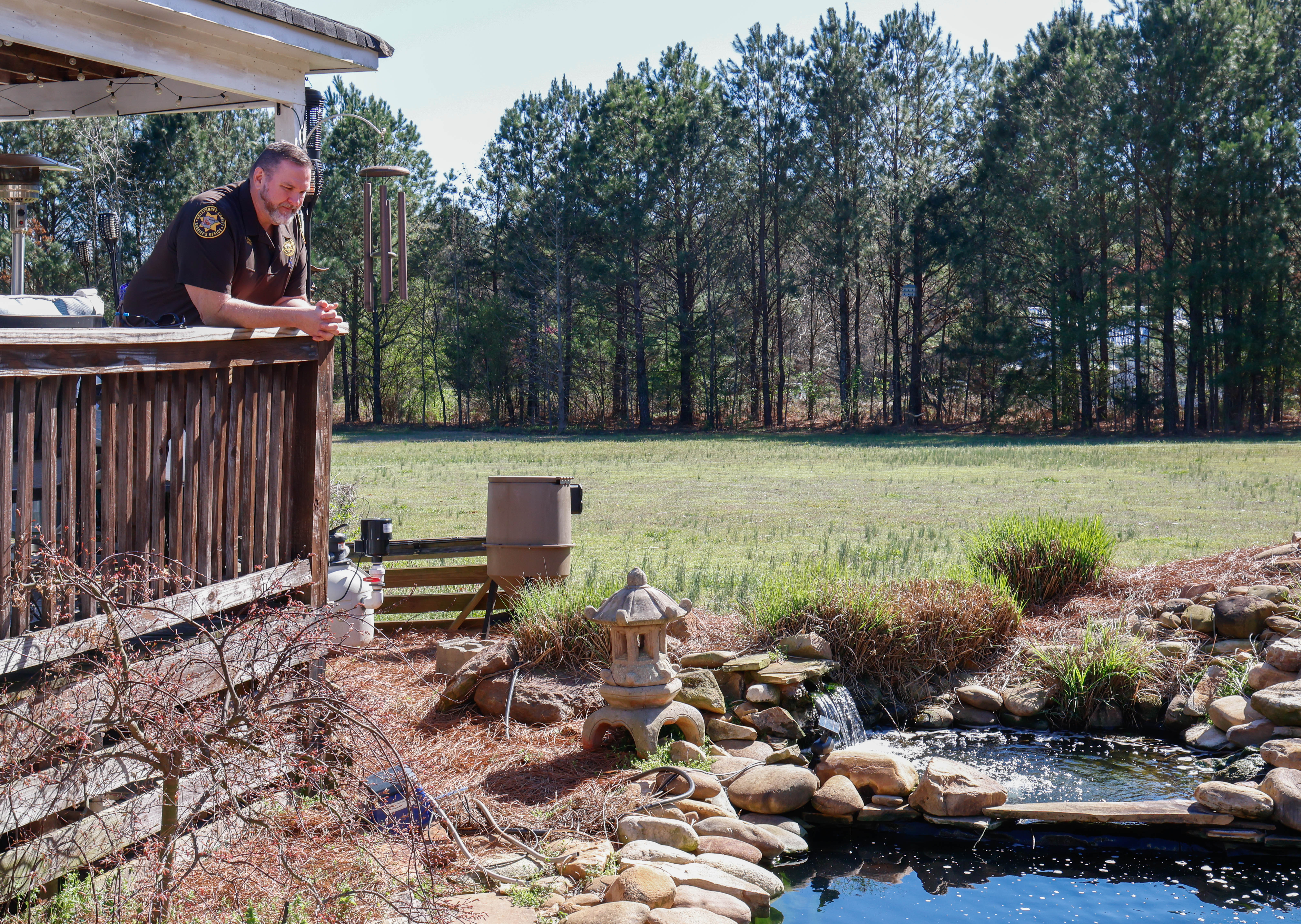
Sheriff David Gabriel sits in the shade of his backyard patio, his uniform crisp and his gun in its holster. A 180-pound cane corso named Biggs drools at his feet, while two much smaller dogs nestle into his lap.
Gabriel’s twin 8,000-gallon koi ponds gurgle gently beside him, and a stone Buddha rests above the water in quiet contemplation.
“You're sitting out here talking to me, do you feel your blood pressure go down a little bit?” Gabriel asks. “Listen to the water, the breeze blowing. The breeze always blows out here.”
In the water before him, 35 koi glide gracefully beneath the surface. Soon, they’ll have company.
Gabriel recently returned from his second trip to Japan, where he purchased 66 more koi that will make their way to Oglethorpe County after a strict four-week quarantine process.
“It sounds like a lot, but you gotta realize I’ve only bought five big fish,” Gabriel said. “The rest are 1-year-old fish, and one of them’s a box of 20. They’re 4 inches long.”
As they age, Gabriel selects the best of the bunch to permanently add to his collection. He raises them in the hopes that they will be competitive at koi shows.
“I'll go through and I'll pick out the ones in that box that I want to keep and use,” Gabriel said. “I'll give the rest of them away.”
Breaking ground
Gabriel’s fascination with koi began nearly 30 years ago, when he helped his dad build a humble pond on the same road where he now lives.
“You start off small, and you keep on building, keep on building, making it better, making it better,” Gabriel said.
When he and his wife bought their house 17 years ago, Gabriel wasted no time building his own pond and even hand-dug it himself. Initially 18 inches deep, it soon proved to be a lesson in trial and error.
A heron devastated his early collection, prompting local koi dealer Carl Forss to give him some advice.
“Carl told me I needed to make it deeper, so I redid the pond to make it 8 feet at that point,” Gabriel said.
Since those early days, Gabriel has learned a lot about koi and their environments. His friendship with Forss and Forss’ wife — Vicki Burnley — certainly helped with that.
The couple owned The Koi Store in Watkinsville together until 2022, when Forss died in an automobile accident on his way back from a koi show. Now Burnley, a former microbiologist at UGA’s college of veterinary medicine, runs the store.
When Forss died, he was carrying hundreds of koi in his vehicle. Approximately 30 survived the crash. Afterward, Gabriel brought his son, Austin, to The Koi Store.
Burnley gave him one of the surviving fish, and Austin named it Carl, in memory of their friend.
“We call it his ‘Last Ride Fish,’ ” Gabriel said.
Straight from the source
Gabriel returned from Japan just weeks ago.
During his first visit in March 2024, he said he felt overwhelmed by the language barrier. English is rare in the small town of Niigata, where koi farms abound.
“The farther away from the big cities you get, the less English they speak,” Gabriel said. “We go to, like, Oglethorpe County, Japan.”
Determined to communicate better, he began practicing Japanese daily. By his second trip, he said he could “pretty much get the gist” of conversations he overheard.
Gabriel goes to Japan with other koi enthusiasts, not only selecting fish for himself, but also advising others on their purchases.
“When (you) go to Japan, you buy more because you have the opportunity to see more fish, right?” he said. “You go through and you refine. … You might buy 10 fish, you might keep two.”
As koi age, their value increases. Buyers like Gabriel look for fish with certain body structures and traits favored at koi shows.
Surprisingly, Gabriel said the pattern or beauty of a fish doesn’t matter much to judges. Body composition is 40% of the score.
“Think of a torpedo,” Gabriel said. “It's a little wider at the front, tapers to the back. Nice, straight lines. No belly. You don’t want a belly or anything like that.”
Buying an older fish with favorable features is much more expensive than taking a gamble and buying a lot of very young fish, which may or may not develop favorable traits.
Burnley said prices for fish can vary significantly.
“One-year-olds? $50 to $150. Those are baby-babies,” Burnley said. “Those big girls? The most expensive fish we ever sold was $90,000.”
She paused.
“That's $90,000, not yen.”
The most dedicated koi hobbyists are typically of a wealthier, older demographic, according to Gabriel.
“You’ve got to have a little bit of money to do koi hobby on that level,” he said. “Most of them are really low key, laid back. You don’t see frat boys getting into fights at koi shows, which is nice.”
For many, koi are more than pets. They’re an investment.
Burnley said it’s “risky business,” but many buyers she works with are willing to take that risk. The Koi Store offers azukari services, which means people without ponds of their own can buy fish and pay Burnley to raise them in her facility. The service costs approximately $1,000 to $1,500 per fish.
“Know this — we put it out there in a mud pond, we’ll do our best to protect it, but nature usually wins,” Burnley said. “If something happens to it, you’re out of luck. (Azukari buyers) have to sign a waiver.”
Risky business
Gabriel is all too familiar with these risks.
The first koi he and his kids ever bought was named Saturday, because they bought it on a Saturday. That was in 2007.
Saturday and Carl, the “Last Ride Fish,” were two of the family’s most special koi. They both died last year in a pH disaster that also killed Gabriel’s biggest fish, a Karashigoi.
Now, no more fish have names.
“As kids, we had cows,” Gabriel said. “You don’t name them, in case something bad happens. I had three named fish. They all died at the same time.”
Koi have long lifespans — more than 25-30 years, if they’re treated well. But nature is unpredictable.
Gabriel once took 20 koi to his 5-year-old granddaughter in North Carolina. The pond was spring-fed.
“Then otters got in,” he said. “Killed all the fish within a week.”
Bigger aspirations
Gabriel’s aspirations extend far beyond his own backyard.
Last year, he was accepted into a rigorous training program to become an American koi judge.
He’s currently a student judge, attending koi shows and observing the judging process with the guidance of a mentor.
Once he passes a basic knowledge test, he’ll become a candidate judge for two years. Candidate judges are able to vote in koi shows while still learning and observing.
After those two years, he’ll take a final test to become a certified judge through the American Koi Judges Association.
But that’s only the beginning.
His ultimate goal is to become a Zen Nippon Airinkai (ZNA) judge. Completion of the required nine-year training program would qualify him to judge koi competitions around the world.
“This is my retirement plan,” Gabriel said. “My wife and I can travel the world a bit, check things out.”
Gabriel, who was elected to his third term last year, said he hopes to serve one more before retiring.
His wife said she’s grateful he found the koi hobby and she supports it wholeheartedly.
“I find peace in knowing he has a healthy hobby that he enjoys,” Kara Gabriel said. “Especially given the day-to-day stresses that accompany his job.”
A passion, a community
Being a koi hobbyist isn’t as relaxing as it might seem. Upkeep is a chore, and Gabriel is always busy repairing plumbing and filtration systems.
But, he said, the hard work is worth it.
The koi hobby introduced him to Forss and Burnley. It also introduced him to other koi enthusiasts around the world, where Gabriel said he’s found a community.
It even spills into his professional life. His koi ponds have become a gathering place for deputies and staff from the Sheriff’s Office, where he and his wife often host brisket cookouts.
Gabriel frequently helps out at The Koi Store, even enlisting deputies to dig mud ponds for Burnley. Chief Deputy Jason Taft’s teenage daughter works at the store after school.
In a high-stress job that keeps him on call nearly 24/7, the koi hobby has given Gabriel a peaceful oasis at home.
“Sit there and watch the fish,” Gabriel said. “Watch them move around the water. It's just natural.”
See a full photo gallery here.