
Lorelei Prichard’s family expressed interest, about a decade ago, in a hobby that’s increasingly popular in the Southeast — raising and showing cattle. But Prichard, a mother of five in Watkinsville, decided purchasing five cows was too large of a financial commitment and opted for something more cost-effective: pigs.
What initially seemed to be budget friendly has proven to be equally, if not more, expensive as pig farmers deal with the skyrocketing price of feed.
Prichard, who owns OMG Show Pigs in Watkinsville, paid $970 for three tons of feed two years ago.
Now, she pays a staggering $1,650.
“A lot of people think, ‘I’m going to save money, and I’m going to make my own pigs,’ and then they realize it’s a whole lot more expensive and a lot more trouble than they were expecting,” Prichard said. “Everything seems easier until you try to do it.”
Feed costs are now responsible for approximately 70% of the total cost of pork production.
Oglethorpe County, which led the state in feeder pork production in 2021, according to the University of Georgia Center of Agribusiness and Economic Development’s Farm Gate Value Report, doesn’t produce enough corn or soybeans, two crops popular in pig feed, to maintain a self-sufficient pig farming ecosystem.
So, farmers in the county rely on imports to feed their pigs, but rising production and transportation costs have driven up prices.
The rising costs have made it difficult for local farms to keep up with commercial farms that have vertically integrated. Vertical integration in hog farming is when one company controls all aspects of the supply chain, from breeding and raising hogs to processing and marketing the products.
Some smaller farms have opted to feed their pigs with an integrator. When farms do this, they typically have an agreement with a larger company that will provide the necessary resources for production, including feed, in exchange for a percentage of the final pork product.
“There’s only a couple left in the county, and they’re not affected by the price of feed because they’re feeding with an integrator,” said Danny Sanders, owner of Oglethorpe Feed and Hardware Supply. “That’s the way hogs have gone in this day and time.”
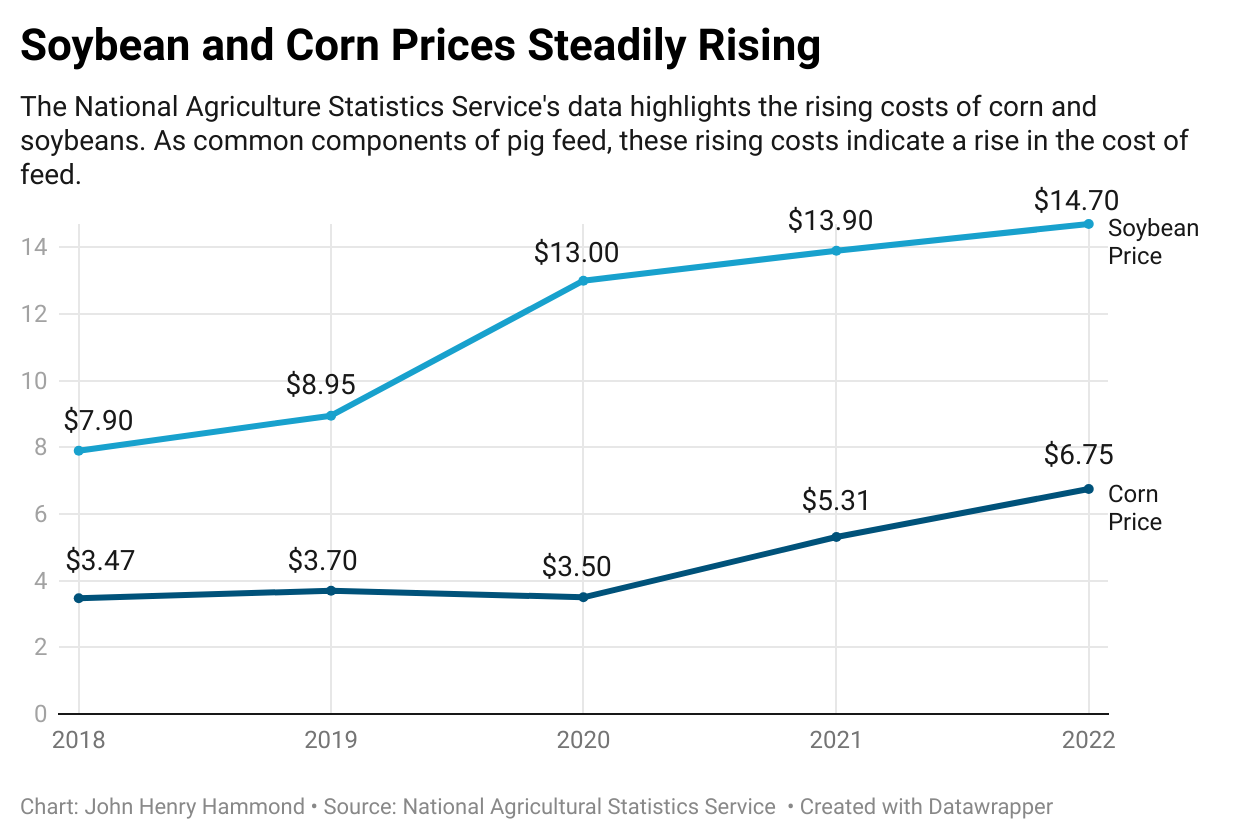
In 2018, corn cost $3.47 per bushel. Just five years later, that price jumped to $6.75 per bushel. Within that period, soybean prices rose from $7.90 to $14.70 per bushel.
Pig farmers are grappling with the challenge of maintaining profitability with both the rising cost of feed and the declining price of pork.
“It’s so expensive, and the price of pork is so low, so it is hard to make a good living out of it,” Prichard said.
She’s not alone in her concerns.
Pork farmers across the country are feeling the implications of rising production costs. Nationally, pork production has fallen 4.8% from 28.3 billion pounds in 2020 to 27 billion in 2022, according to the U.S. Department of Agriculture’s Economic Research Service.
“The swine industry across the country right now is probably in a little bit of a contraction mode,” said Robert Dove, associate professor and undergraduate coordinator of Animal and Dairy Science at the University of Georgia. “It's a little hard to tell, but we are decreasing the number of sales and breeding stock.”
Despite the negative outlook, Prichard encourages individuals to consider entering the industry, as she believes that raising pigs can impart valuable lessons and insights.
“The kids that do this, they’re coming out from showing pigs and learning how to talk with people and communicate,” Prichard said. “They’re learning responsibility, they’re learning the cost of their food and they’re learning that everything has a purpose in life.”