
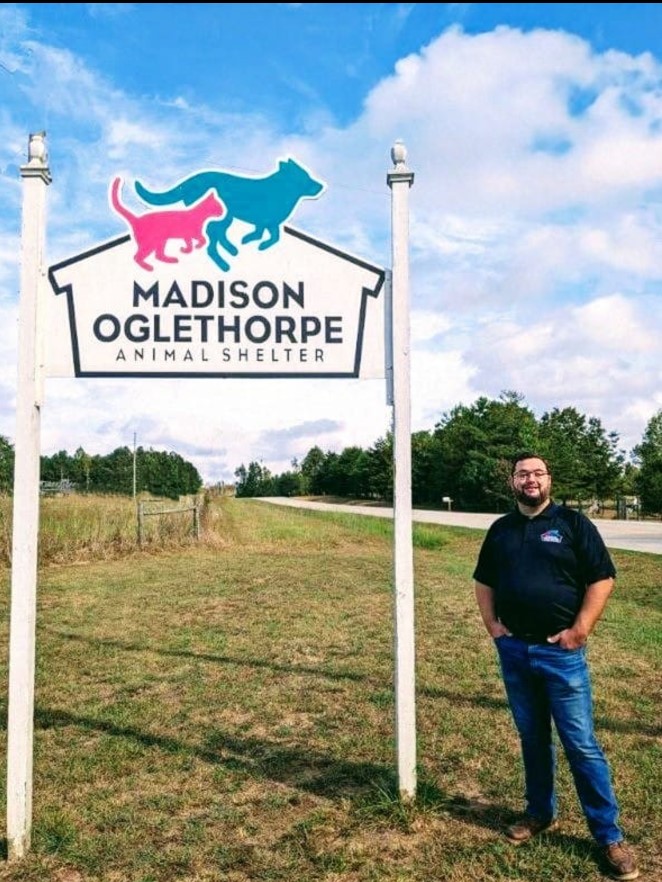
The Madison Oglethorpe Animal Shelter (MOAS) hired William Stevenson as its executive director in September. Stevenson has spent the past several years of his career in animal control for Gwinnett and Barrow counties, working his way up from kennel tech to animal cruelty and neglect investigator.
When Stevenson arrived at MOAS, the shelter was closed to the public, but has since reopened.
The Oglethorpe Echo spoke with Stevenson about his plans and goals for MOAS.
Comments have been edited for length and clarity.
Q: You’ve worked in animal welfare for a long time. How have your experiences working your way through the ranks informed how you’re going to approach this new role?
Stevenson: I’ve had some really good directors who I’ve learned quite a bit from. One of them, his name was Alan Davis. He was my director at Gwinnett County Animal Welfare, and he’s very compassionate and very community-oriented. What I learned from him was to approach community outreach as more like a teaching opportunity than an enforcement or punishment opportunity. One of the big things I want to do here is to educate the public rather than punish the public for something that they had no clue about.
Q: Are you an animal lover yourself?
Stevenson: I am. I do enjoy having animals. I grew up on a cow farm in South Georgia, and we always had animals all over the place. We had guineas that would protect the driveway and donkeys in the field.
That being said, it surprises people that I don’t really have animals at home. I don’t have time for them, to be completely honest with you. I have personally seen the consequences of not being able to spend time with your animals, so me being somebody that works 50-, 60-plus hours a week, it just feels like a disservice. That being said, I’ve got 200-plus animals here.
Maybe one day I’ll have a cat.
Q: How are you finding this transition from working for government agencies to working for a nonprofit?
Stevenson: Frustrating. To be completely honest with you it’s frustrating. When I came into my job here, we were shut down. We went through a period where we were closed to the public.
So coming in immediately, boots hit the ground. I had to start by trying to get everything back up and running again and open to the public. I started changing certain things, like policy and procedures to meet up with the times and be on the standard of what other shelters and nonprofits are doing. It’s been difficult, and it’s still difficult.
We have changed biosecurity protocols. We have changed cleaning protocols, animal housing procedures and medication policies. It’s almost like bringing the past to the present at breakneck speeds, and some of the staff is not happy with it. Some of the public is not happy with everything. Some of them are excited about it. Some love it.
It’s something that I knew was going to happen when I came into this position. You’re not going to make everybody happy right off the rip. And in order to continue to give excellent service to not only members of the public but to the animals that we house in here, we have to make these changes.
Q: Could you tell me more about the state of the shelter when you came into this job?
Stevenson: I would never call out previous management, previous staff or anything like that. I just feel like the shelter kind of lost its way. At the end of the day, this is a business. And if we don’t keep our doors open, we can’t help anybody, we’re not helping the people or the animals of these counties.
They kind of lost the attitude that this is a business instead of this is a friendly place. Coming in here, it’s a resetting of the structure of the shelter and the business to be able to stay open. It would be devastating to lose this place. But it’s kind of what I came into. I came into disarray and dysfunction. Our overpopulation was terrible. We had around 250 cats in the building and about 50 dogs. We had about 300 animals in the building. As of right now we’re running at 181.
Q: What is the maximum capacity?
Stevenson: 150 animals would be our max capacity. So, we’re running just over. We’re comfortable. We can make it work.
Our first month we were right on the cusp. In order to open our doors back up to the public, we had to reduce that number dramatically in a very quick time. We were right on the cusp of deciding to euthanize these animals because we had to open back up to the public. The Department of Agriculture would have kept us closed. So we had to make decisions. With my history and contacts and the contacts of my staff, we were pushing animals out of the building as fast as we could.
As a team, we got almost 90 animals out within a couple of weeks to rescues, other animal controls and volunteers. That saved us from having to euthanize anything. That’s huge. That’s one of the things I’m very proud of, and the staff is very proud of.
Q: You are the fourth executive director at MOAS in the past four years. How do you plan to bring stability to this position?
Stevenson: That’s a tough question. But standard operating procedures (SOPs) are one of the biggest things I’m focused on right now. Our current SOPs are really, really simple. It just needs to be fleshed out. If I handed you our SOPs, they need to be where you can open it and know how to run this place without me ever being here.
We are also changing policies, procedures and getting the board to go over their policies and procedures, too. The board is absolutely phenomenal, but there are some things that need to stay in shelter operations. I’d also like to have regular board meetings and maintain good communication between the board and myself.
I’m also willing to communicate with county government. The government doesn’t scare me away. It’s very easy for me to deal with them.
Q: Looking to the next 12 months, what do you hope to accomplish?
Stevenson: I want us to be financially stable again. I mean, we’ll make it. We’re fine. We’re not going to shut our doors, we are not borrowing money or anything. But I would like to get our financials back to where we can take that bead of sweat off of our forehead.
We’re not losing as much money as we were when I first showed up. We’re trying to find cheaper solutions while also keeping standards high. I’d also like to focus on employee retention and continuing to improve animal welfare. I want to build. I want to make it bigger with a standalone clinic and find better ways to assist the public. I hope to see big changes in the next 12 months.
I also want to thank the community for their support. There are things I want to do that I will try my hardest to do, not only for me, but for my staff, the animals and the community. We can’t do this alone.
Alex Perri is a master’s student in journalism at the University of Georgia. She previously worked at the Transylvania Times in Brevard, North Carolina.