
Board of Education discusses 2022-23 county test scores and upcoming changes in Oglethorpe County schools
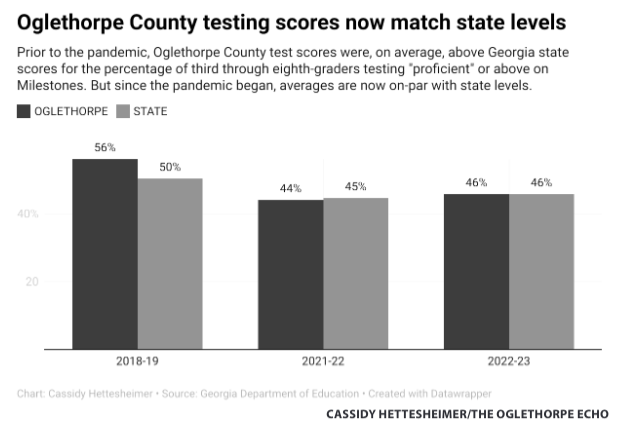
Three years after the start of the pandemic, Oglethorpe County students’ test scores remain below pre-pandemic levels on the Georgia Milestones.
“Prior to COVID, we were ahead of the state,” Superintendent Beverley Levine said. “Since then, we’re now sort of, as you say, on par with the state. That's not where we want to be. We want to be ahead of the state.”
In the 2018-19 school year, across the state-administered end-of-grade exams given in third through eighth grade, 56.1% of the county’s students scored “proficient” or above, averaged for exams across all subjects.
That number was 44.1% in 2021-2022 and 45.8% in 2022-23.
So, the school system is shifting focus to address areas for improvement this year.
While Levine said she recognized the importance of students being “well rounded” outside of testing — both involved and emotionally healthy — Milestones scores impact accreditation and can show areas of growth in the upcoming year.
Levine and assistant superintendent Kanya Cornish have visited the system’s schools to present scores and seek staff feedback.
Cornish said she also plans to revisit grade levels for “data digs” to examine ways to improve testing trends. After initial reflections, Levine said factors contributing to the pandemic decrease could include changes in learning patterns, educator turnover and lack of universal access to broadband during remote learning.

New, old strategies
Levine said the school system will bring back summer school this year, which has not occurred since before the pandemic. Students can retest their Milestones after completing summer school, which may improve scores.
Oglethorpe County Elementary School is also shifting to a rotating departmentalized structure in which teachers specialize in specific subjects, instead of one teacher balancing math, English language arts, science and social studies.
The district also will be “taking a look at” expanding a post-pandemic primary school phonics program into the elementary level, Levine said, but doing so may require “adding another person who could target reading instruction.”
Administrators will also look to best practices in grade levels that scored well. For instance, eighth grade had the highest percentage of students score at proficient levels in reading, ELA and math in 2022-23.
Carol Jordan, an eighth grade math teacher at Oglethorpe County Middle School, said engaging students with interactive activities where they move around the classroom or collaborate can help keep students’ attention after disrupted pandemic learning.
“We have to introduce things differently,” Jordan said. “Gone are the days when you just handed a worksheet out for practice.”
From MAP to Milestones
Prior to the pandemic, Oglethorpe County Schools focused more on national MAP Growth tests, versus Milestones. MAP tests measure student improvement throughout the course of a year, compared to Milestones, which measure meeting end-of-year grade-level standards.
In 2022-23, Oglethorpe County students scored at or above the state average for the majority of its MAP Growth comparisons.
“(A few years ago), our Milestones scores were good, but we felt like we weren't growing our kids,” Levine said. “We had to wait for a year to know whether we had done well, so we need some other measures.”
However, renewed attention toward Milestones means looking at the wording of state standards and teaching concepts with the test’s phrasing, plus reassessing the order of topics taught.
“We realized we would teach statistics and probability prior to the Milestones, and there were three questions on the Milestones,” Levine said. “We were teaching geometry after the Milestones, and there were 15 questions, so our kids hadn't even been exposed to the material.”
Improve regional rankings
The county’s schools’ placement varied widely between subjects and grade levels, ranking from third from the bottom to third from the top, compared to the 12 other county or city school systems in the Northeast Georgia Regional Educational Service Agency group.
In a partnership with Northwest Georgia RESA, the county has tapped into a data mapping service, Data Warehouse Dashboard, to analyze scoring trends.
“I've reached out to one of the (regional) districts … one of the ones at the top, to see, ‘OK, well, where do you start when you're looking at your Milestones data?’ ” Cornish said.
Elevate students
Another targeted area for improvement is the number of students scoring in the top “distinguished learner” category.
In the majority of subjects across grade levels, the county had less “beginning learners”— the lowest scoring category — than the Northeast Georgia region or the state, but also less top-scoring students.
“(Teachers) said they spend a lot of time on the kids who're struggling,” Levine said. “What do they do for the kids that need to be challenged? Kanya and I, that's something we've been charged with helping them (do).”
Levine said they plan to schedule time for “vertical cooperation” between grade level teachers to help challenge students, not relying on “hope and chance.”
Jordan said, in the classroom, challenging top students shouldn’t look like giving them a higher quantity of work, but rather, “higher-level practice” that challenges them to look at processes and catch mistakes.
“We recognize our teachers are working as hard as they can,” Levine said. “We don't for a minute think they just sit there slacking off. But, sometimes you've just got to make some tweaks.”