
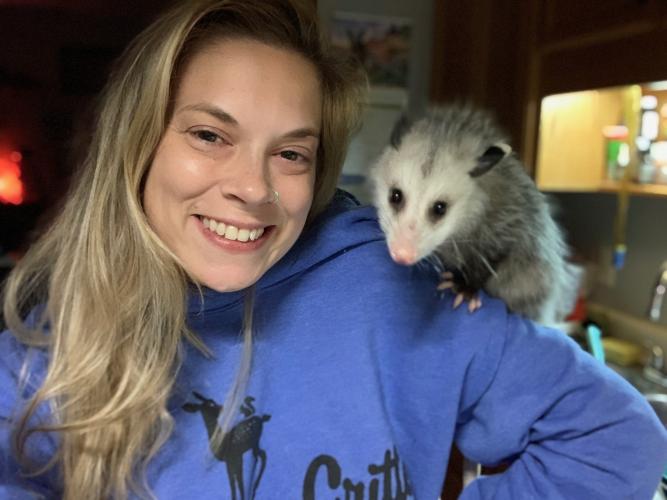
Nikki Hughes
Nikki Hughes started caring for and rehabilitating deer fawn in 2020. During that first year, she released three fawns into the wild.
In 2021, Hughes became licensed as a wildlife rehabilitator and opened Camp Critter Wildlife Rescue in Crawford.
“Within two weeks, we outgrew the facility that we prepped because there’s just not a whole lot of rehabbers around,” Hughes said, “and there are even fewer that deal with deer because deer take more space, more time, more money to raise because we have them for quite some time before they’re able to make it out on their own.”
Camp Critter takes in all kinds of wildlife, including squirrels, opossums, foxes and even a coyote pup, but the nonprofit specializes in caring for young deer. Fawning season usually starts around Mother’sDay and runs until late August or early September. Hughes said the average number of fawns rehabilitated at Camp Critter is between 50-100 per season, and has grown significantly with each year.
Many of these fawns come into the care of Camp Critter after car collisions that have killed their mothers or left the fawns with injuries that would be fatal if untreated.
Deer collisions in Oglethorpe County are common, especially during times of increased movement like fawning and mating seasons.
Since the beginning of his first term in 2021, Jay Paul, chair of the Oglethorpe County Commission, has picked up 86 deer that have been killed in car collisions, with 12 of those in 2025.
“It’s an interesting paradox, because you have more congested parts of the county where there’s more people and more traffic, there may not be as many deer but there’s more traffic, so some more deer may get hit,” Paul said. “Or you get out to some of the more rural areas of the county where there’s not as many people, but there’s more deer so you still have accidents.”
Paul said the county is working on improving visibility along roads by mowing the grass, but with 250 miles of paved roads, this takes over three weeks to complete. Hughes said the easiest way for people to avoid collisions with deer is to slow down and stay alert.
“People are comfortable, they’re familiar with where they are and maybe they’ve become desensitized to watching for deer,” she said.
Collisions are still inevitable, but preventative measures can result in fawn injuries rather than fatalities. Both Hughes and Paul witnessed when Paul came across a fawn in Devil’s Pond and called Hughes.
“Somebody had hit it. Now you could tell they tried to slow down, obviously, because the fawn was still intact,” Hughes said. “It’s doing great by the way. It’s made an awesome recovery, but point being, that he was found on the center line in the middle of the road. They didn’t even stop and move him out of the road.”
Hughes has requested deer crossing signs to be put up near Camp Critter to avoid rehabilitated deer being hit after they’ve been released, but after several months of waiting to have the signs installed, they disappeared.
“They got the signs up, I was so excited and I posted all over thanking the county for them. I was very appreciative,” Hughes said. “They weren’t up six months and somebody came and stole them.”
Paul said that isn’t the first time this has happened since deer crossing signs appear to be “quick collectible items to people.”
In the event of a deer collision, Paul said drivers should make an accident report if the damage is worth filing on their insurance and to report a dead animal so it can be removed from the road.
“If the dead animal is reported to us in a timely manner, we’ll do our best to get out there,” Paul said. “If it’s been more than a couple of days in this weather, it’s hard for us to deal with. That happens occasionally. They’re just too far gone for us to move them off the right of way. We need everybody’s help.”