
More info
The Oglethorpe County Bee Club meets from 7-9 p.m. Monday, May 20 at the Farm Bureau. Visit youtube.com/@theoglethorpeecho or our website (theoglethorpeecho.com) to see beekeepers at work.
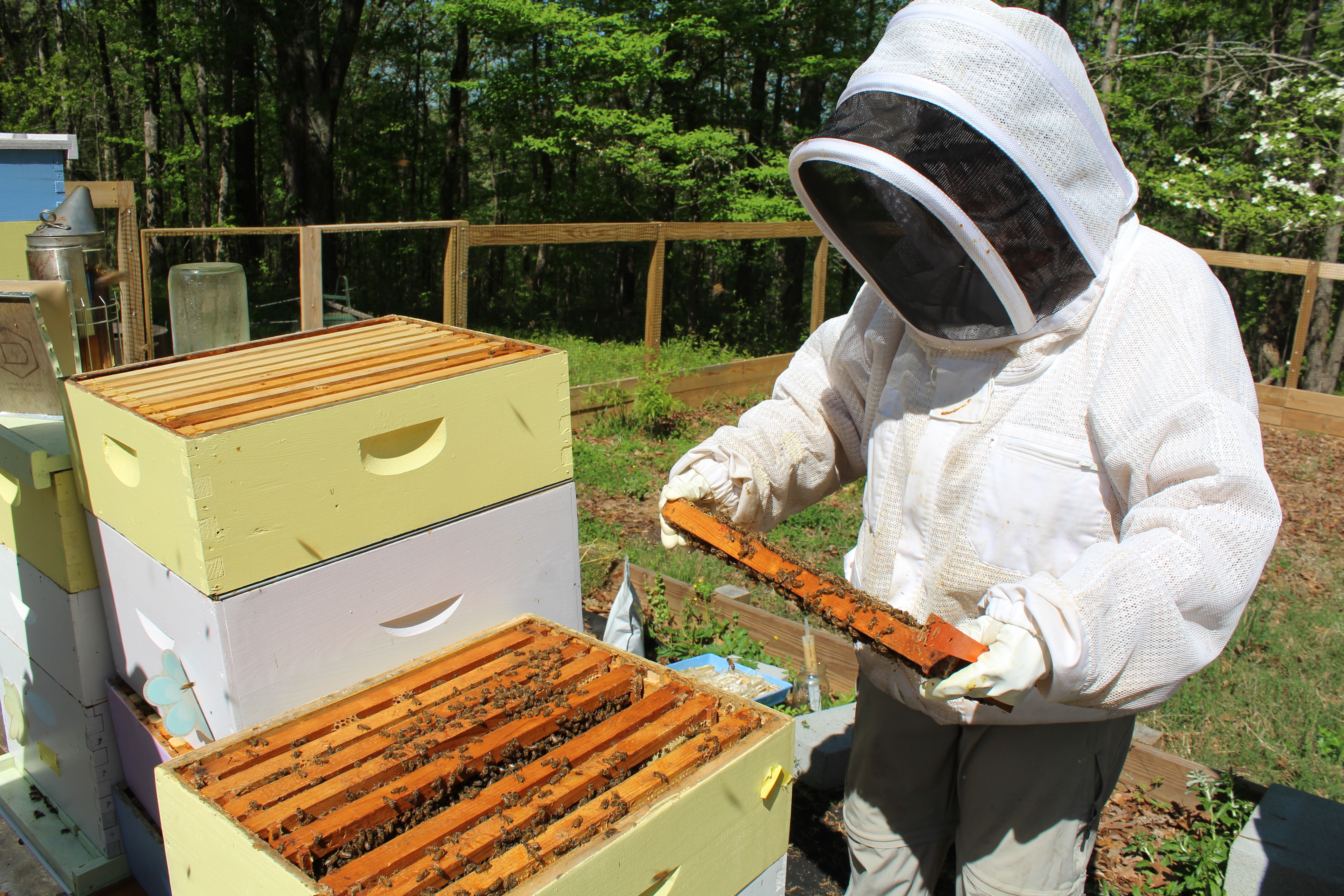
A faint buzzing comes from the row of stacked wooden boxes in Elizabeth Mackey’s backyard, quickly turning into a roar as she and friend Heidi Simmonds open the lid to release a swarm of bees.
As spring brings warmer weather, bees are getting to work in their hive — and so are beekeepers, who use this time to inspect the hives.
Many of the stacks of boxes painted white, yellow, blue, green and purple are three boxes high, while others are up to seven. Inside each box are frames that give thousands of bees a place to make food or honey, and lay eggs.
“On average, a beekeeper has about 60,000 bees,” said Mackey, president of the Oglethorpe County Bee Club.
Because they are pollinators, bees are essential to agricultural production, with the USDA reporting that more than one-third of all crop production requires insect pollination.
Although the number of bee colonies has nationally decreased within the past year, the 2022 Census of Agriculture reported the number of bee colonies in Oglethorpe County rose from 21 in 2017 to 70 in 2022.
The statewide number of hives also increased, from 119,609 in 2017 to 174,196 in 2022.
Mackey, who keeps the hives at her home in Watkinsville, has begun to enter her hives again to see how the bees held up over the winter. She looks for brood, or offspring, to know that the queen is reproducing successfully. However, she also has to keep an eye out for pests that could threaten the hives.
Because boxes and frames can get heavy when containing honey and brood, it helps to have an extra set of hands. Mackey sometimes works with her friend Heidi Simmonds, another local beekeeper and member of the Oglethorpe County Bee Club.
“I was hooked from when somebody came to our church and did a little presentation on the importance of bees,” said Simmonds, who lives in Athens.
During the winter, the bees are left alone with plenty of sugar water since they can’t gather pollen for food at that time.
Bees and beekeepers are active during warmer months.
What does an inspection look like?
In order to inspect the bees, a beekeeper must wear long pants, long thick gloves and a bee jacket. The jacket covers a beekeeper’s head and neck with a mesh material to ensure they will not get stung on the face.
“Even with protective gear, you run the risk of being stung,” Mackey said. “The stinger is barbed, and so it’s gonna stay in you. You want to pull it out or scratch it off or it will keep putting venom in you.”
The boxes must be lifted off of each other one at a time. Then, the frames are pulled out to inspect for honey, which appears like a yellow or white paper when it is finished and capped by the bees.
“When we, as beekeepers, are taking care of them, we want to always make sure we don’t take too much honey and starve the bees," Mackey said. “We want to make sure that they’re healthy, that they’re disease-free and that we don’t have any problems.”
Beekeepers also have to look for signs of pests in order to ensure the hive is healthy and properly treat it if a threat is present.
“We’ve got a couple different kinds of pests,” Mackey said. “One is a hive beetle. It’s an obnoxious little creature that eats the wax, and it’ll take over.”
When Mackey and Simmonds spotted the small black bugs in a few frames, they squished them.
“I’m never bored because you never know what you’re going to see, and then you have to troubleshoot,” Simmonds said.
Another important item the beekeepers look for during inspections is brood, which looks more like cardboard coating the honeycomb cells.
Brood is a sign that the queen is reproducing and the hive will continue to grow.
“One of the things we look for is my queen still laying lots of fertilized eggs, because if she’s not doing a good job laying, well it’s not gonna get any better and it’s time to get rid of that queen and get a new queen,” Mackey said.
Both Mackey and Simmonds said they enjoy beekeeping together and learning from other beekeepers in the bee club.
“There’s still so much to be learning,” Mackey said. “And I have fun working with Heidi because we don’t always agree. And so then, it’s like a marriage relationship. You know, you got to find a compromise because you can’t just do nothing. You have to work through it.”