
OCHS counselors work closely with students to set, meet goals
Melissa McGarity describes the moment seniors walk across the graduation stage at Oglethorpe County High School as bittersweet.
“It’s such a proud day,” said McGarity, an OCHS counselor for 10th and 12th grade students. “But at the same time, it’s also so sad because I get so attached to a lot of the kids, and I hate that they’re leaving us.”
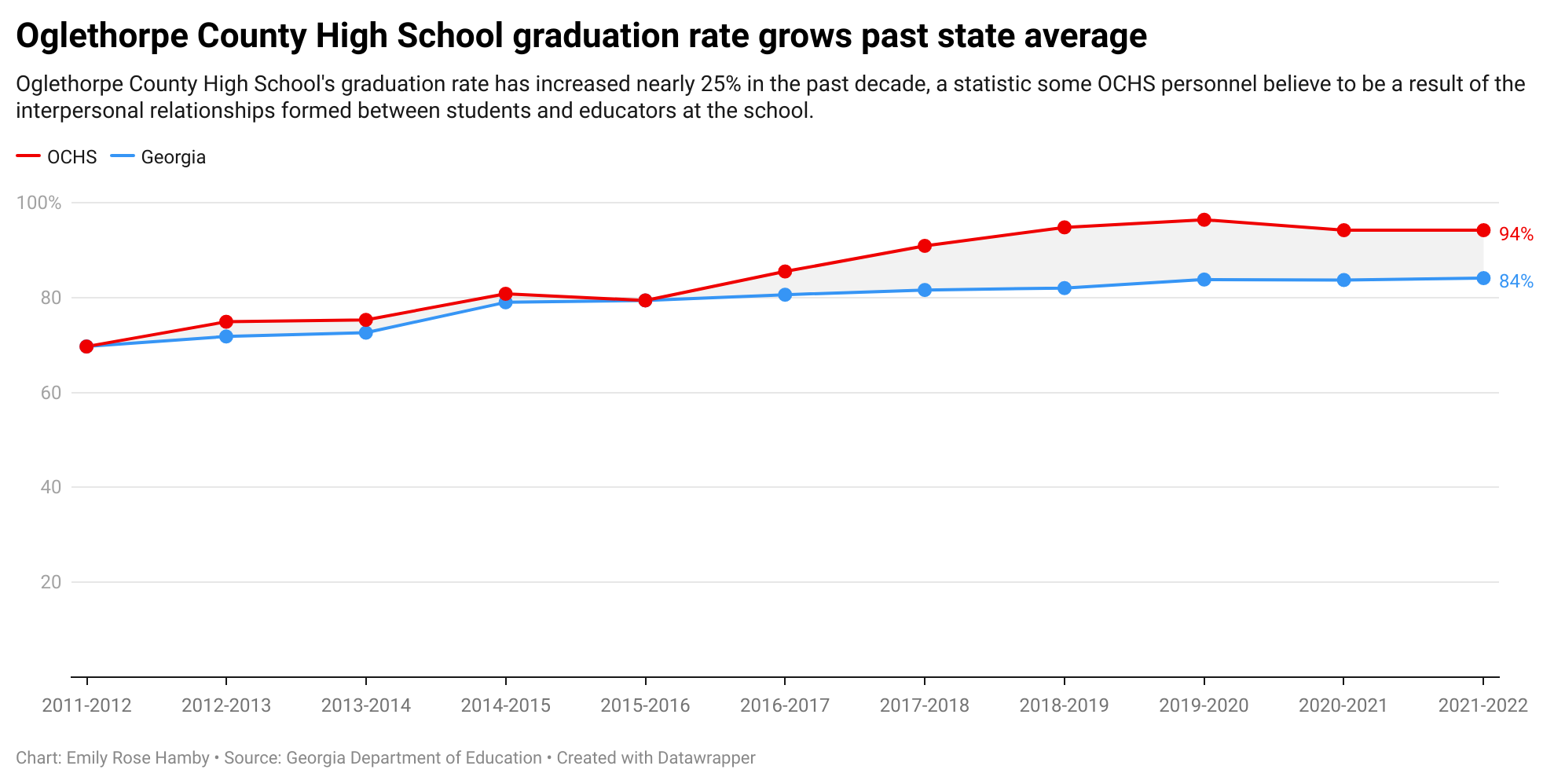
OCHS’ graduation rate has seen strong growth the past five years. For the 2021-2022 academic year, the graduation rate was 94.2%, more than 10% higher than Georgia’s average rate of 84.1%.
While the graduation rate has increased, the graduating class size was smaller last school year: 133 students graduated this spring, compared to 141 in 2021.
“It’s great, (but) I wish it was 100%,” McGarity said. “There are things that are not in our control that get in the way of that. I think the county as a whole has a lot to be proud of.”
Superintendent Beverley Levine considers the high school graduation rate a reflection of the connections made between the OCHS counselors and students throughout their high school careers.
The approach used to support OCHS students in securing their diplomas varies between grade levels, but by working with students from the time they arrive at the high school until their senior year — and meeting the specific needs of each student — counselors have found success in helping with both academic and post-graduation goals.
“I think so often, we put our emphasis on our seniors, making sure we're getting them across the line,” Levine said. “But they realized at the high school (that they) need(ed) to be focusing on ninth (and) 10th graders, which is where you could typically lose a lot of kids.”
Building a foundation
The counselors begin making vital connections with students once they enter OCHS.
According to the Washington Student Achievement Council, ninth-grade students who fall off track have “very low odds of earning a high school diploma.”
Erica Hughes, the ninth and 11th grade counselor at OCHS, said it’s important to support ninth grade students and help them get comfortable in their new academic environment.
The freshmen meet regularly with their counselors and work on maintaining their grades. They participate in “check PowerSchool days” every five weeks to evaluate their overall academic progress.
“(Mrs. McGarity) has kept everyone on track with grades,” said Anna Rose Adams, a junior. “She makes sure if you have a bad grade, she’s calling you into her office.”
The counselors encourage ninth graders to create monthly and long-term academic goals. The students also participate in “future self activities” to help them start thinking of their post-graduation plans, Hughes said.
To help build these relationships with the ninth graders, the OCHS counselors meet with the counselors from Oglethorpe County Middle School to discuss and learn more about the new students arriving at the high school. McGarity said the OCMS counselors help them know which students might need help with their academics.
“It's a lot of involvement on our end, starting off as early on as possible to make sure that they have that good foundation that sets the tone for them as they approach their senior year,” Hughes said.
Planning for the future
While sophomores continue to receive academic support from counselors, 11th and 12th grade students begin to create a plan for when they leave OCHS.
According to an Arizona State University study, “having a future goal dependent on graduating high school, such as going to college or getting specific career training, can help keep students on track.”
McGarity said the counselors have always met with the students one-on-one to touch base during the year; however, the educators started to focus more on juniors and help them plan their future goals two years ago as a best practice strategy.
“We do a little bit at a time in junior year, just to get them researching and get them to think a little bit outside the box and see what’s out there,” Hughes said. “That way, when they come in for their final year of high school, they’re like, ‘This is what I wanna do, this is where I want to go, and I’m ready.’”
To help students with college and career readiness, the counselors said they use resources from the Georgia Career, Technical, and Agricultural Education (CTAE) Network. This nonprofit organization provides instructional career development information to educators in Georgia.
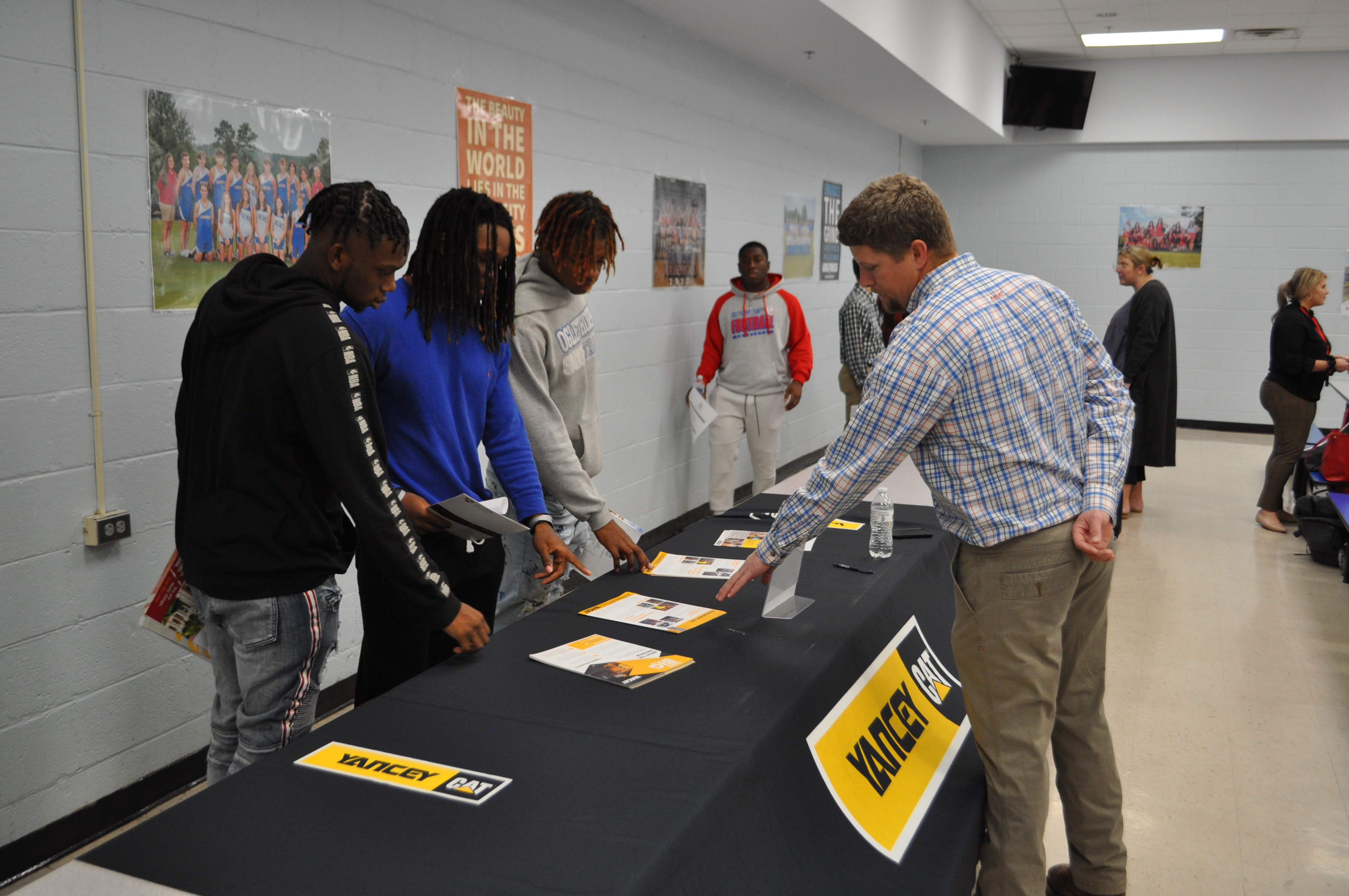
The counselors hosted a college and career fair on Oct. 26 to help the 11th- and 12th-grade students explore post-grad options. Hughes said OCHS hasn’t hosted the fair “for several years, even before COVID.”
Since each student has different goals for when they graduate, the fair highlighted a broad range of opportunities for students to explore. Representatives from 10 colleges, eight businesses and three branches of the military talked to the juniors and seniors at the fair.
Students were also provided a list of sample questions they could ask the college and business representatives. Hughes said this helped students practice asking questions and get exposed to different opportunities.
“Our students have been very receptive to (the college and career event) and they learned a lot about places they didn’t know about and were not aware of,” said Susie Johnson, OCHS principal. “I’m very happy to have vendors who come here to represent real work, even if college is not one of the things that (the students are) interested in.”
During their senior year, students receive assistance from the counselors in filling out college applications, applying for financial aid scholarships, finding post-grad jobs or joining the military. McGarity said the counselors also spend a few weeks helping seniors set up their Free Application for Federal Student Aid (FAFSA).
Of the 133 students who graduated last spring, McGarity said 60-70% reported attending college, about five students joined the military and the rest went into the workforce.
Senior Dalia Padilla said that as a first-generation incoming college student, it’s tough to navigate the college application process. Padilla asked the counselors for assistance.
“(McGarity) has helped me be able to get signed up for the SAT and all that stuff,” Padilla said. “I’m really thankful for her, because, if not, I would have probably just stopped and not done anything.”
Preventing dropouts
Despite OCHS’ above-average graduation rate, it’s inevitable for some students to struggle to find the motivation to graduate. Circumstances beyond academics often play a role in preventing any school’s graduation rate from being 100%.
“Sometimes students have certain personal events occur within the home that sometimes hinders their academics and the school,” Hughes said. “Sometimes students come with such a heavy load or a heavy burden outside the school that (makes it) sometimes hard to focus on school. It's not a perfect system. We definitely try what we can.”
Hughes said attendance has also become an issue for some students.
“Especially for our older students,” Hughes said. “Some of them start working a lot after school. So we do our best to compare school attendance with academics. Also, just making them see the connection as they get older ‘If I don’t go to my job every Monday, eventually I’m going to lose my job.’”
When the high school begins to notice a student who is struggling, educators and staff will step in and provide support. It becomes a team effort, McGarity said.
“Their coaches get involved, their former teachers,” McGarity said. “The amount of support and people that our kids have pulling for them in trying to help them along is definitely, I think, a factor that our kids are blessed to have.”
A community effort
The success that OCHS has found through its strategy of forming relationships between counselors and students is effective, in part, due to the size of the school district. The small, tight-knit community creates a sense of familiarity among people, especially in the schools.
“Having a smaller population (of students), I think there's a lot more flexibility to do some of the things, like meeting with students individually,” Hughes said. “We don't have (administrative) responsibilities that pull us away, so we're able to do our job and do our job effectively.”
However, it’s still a challenge for the counselors to have enough time to meet with every student.
“I wish there was more time in the day that we could spend with kids,” McGarity said. “Even though there's two of us and roughly only, about 330 kids apiece. I mean, we're really in a good situation compared to some other schools in the state and in the country, as far as our caseloads. But you know, just (more) time.”
For school districts looking to improve their graduation rates by implementing a similar, relationship-driven program, Hughes and McGarity emphasized building solid, foundational relations with teachers and students, as well as establishing an integral connection with ninth graders.
Hughes said the counselors plan to continue supporting each student throughout their four years at OCHS until they graduate.
“We're definitely gonna continue what works, and we always try to add a little bit every single school year, just making sure we're available and maybe the frequency that we meet with students and just making sure we keep a good connection with teachers,” Hughes said.