


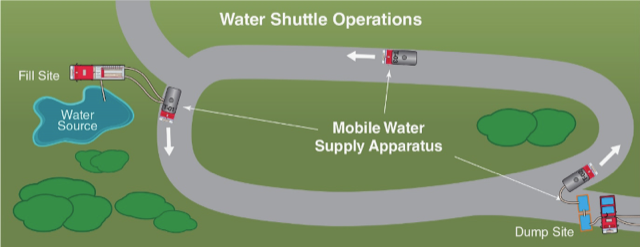
This graphic depicts how the tankers refill and dispatch on scene. (Graphic submitted by Cody Gibbs, credit to International Fire Service Training Association (IFSTA))
Cody Gibbs was the first one to reach the scene of the fire that day, and he knew it was massive.
“I could see the glow of the fire as I left my driveway, which was about a mile, mile and a half away,” Beaverdam’s assistant fire chief said. “I knew that the fire was big, and so I requested dispatch to go ahead and dispatch the Tanker Task Force.”
The Tanker Task Force, an extra county force that helps supply needed water when hydrants are absent or dry, started as an idea in 2021. Several stations were concerned about the lack of water supply at that time.
In 2022, the force officially started, and now nearly every station has its own tanker to contribute to the cause.
“We have a great team in Oglethorpe County,” Vesta assistant fire chief Michael Moravek said. “It's awesome.”
The tankers are trucks that can hold anywhere from 1,200 to 3,000 gallons of water. When a structure fire occurs within Oglethorpe County, they dispatch along with the engines to make sure that enough water can be supplied.
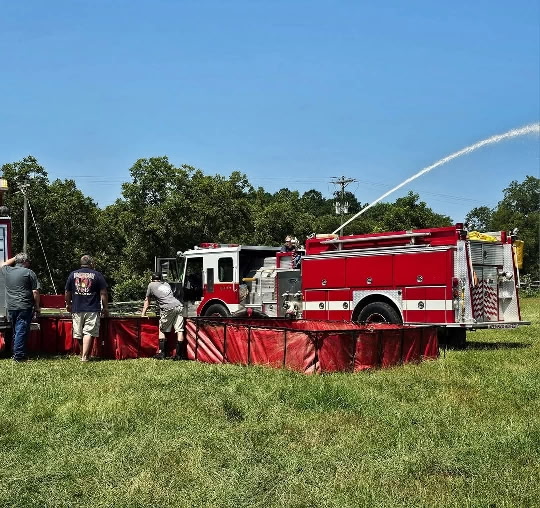
On scene, they set up a drop tank next to the fire engines. The “small swimming pool,” as Moravek described it, holds around 2,500 gallons of water to keep the trucks full.
In some cases, these methods have provided 20,000 gallons of water on the site.
“Our county doesn’t have a lot of hydrants for fire apparatus to use for firefighting operations,” Gibbs said. “There’s a lot of different counties that use this type of task force, but we came up with the idea to try to solve some of the issues that we had with water.”
Communication is key when it comes to the task force, and the organization of the group depends on the type of fire and its severity.
Gibbs said the county is broken into four quadrants, but when a fire is large enough, tankers can come from anywhere if they are available.
Whenever the task force is dispatched, firefighters can use an app that each station uses to track whether or not the tankers will arrive soon. Then, radio communication becomes key as they begin supplying to the trucks or exhausted fire hydrants on scene.
“(It’s) either us communicating with our 911 dispatch what we need, or what we're asking them to dispatch more of, or if we’re kind of communicating among one another on the fire ground,” Gibbs said.
When on scene, that communication becomes even more essential, Gibbs said. It aids getting the water to the trucks and refilling the tankers.
Typically, what is referred to as a “nurse tender” sits at a natural water source or another fire hydrant in case they need more water.
“We could also set up the turbo draft system,” Moravek said. “It’s basically a mobile fire hydrant. So you have an engine set up at the rock quarry, say, and we would be filling up trucks — tankers — with the turbo draft system.”
Although not every fire station relies heavily on the tankers, their presence doesn’t go unnoticed. Stations like Arnoldsville, which have fire hydrants in the area, don’t utilize the tankers as much, but they still occasionally get called out.
In fact, nearly every structure fire in the county has the task force dispatched.
Kelly Huff, the chief at Sandy Cross, said tankers are essential to his job.
Gibbs said for the parts of the county without fire hydrants, the tankers are crucial.
“In my experience, the scenes that I’ve been on that we’ve used the Tanker Task Force, it has been a very positive thing for the county,” he said.