
Gresham’s research helps reveal Wolfskin culture that included parts of several counties
The Native American history of Oglethorpe County has remained largely unexplored, with its presence faintly echoed in local landmarks and scattered archaeological finds.
But retired archaeologist Tom Gresham said the county contains far more Native American sites than most residents realize, with 666 identified and recorded.
And that’s only a fraction of what once existed.
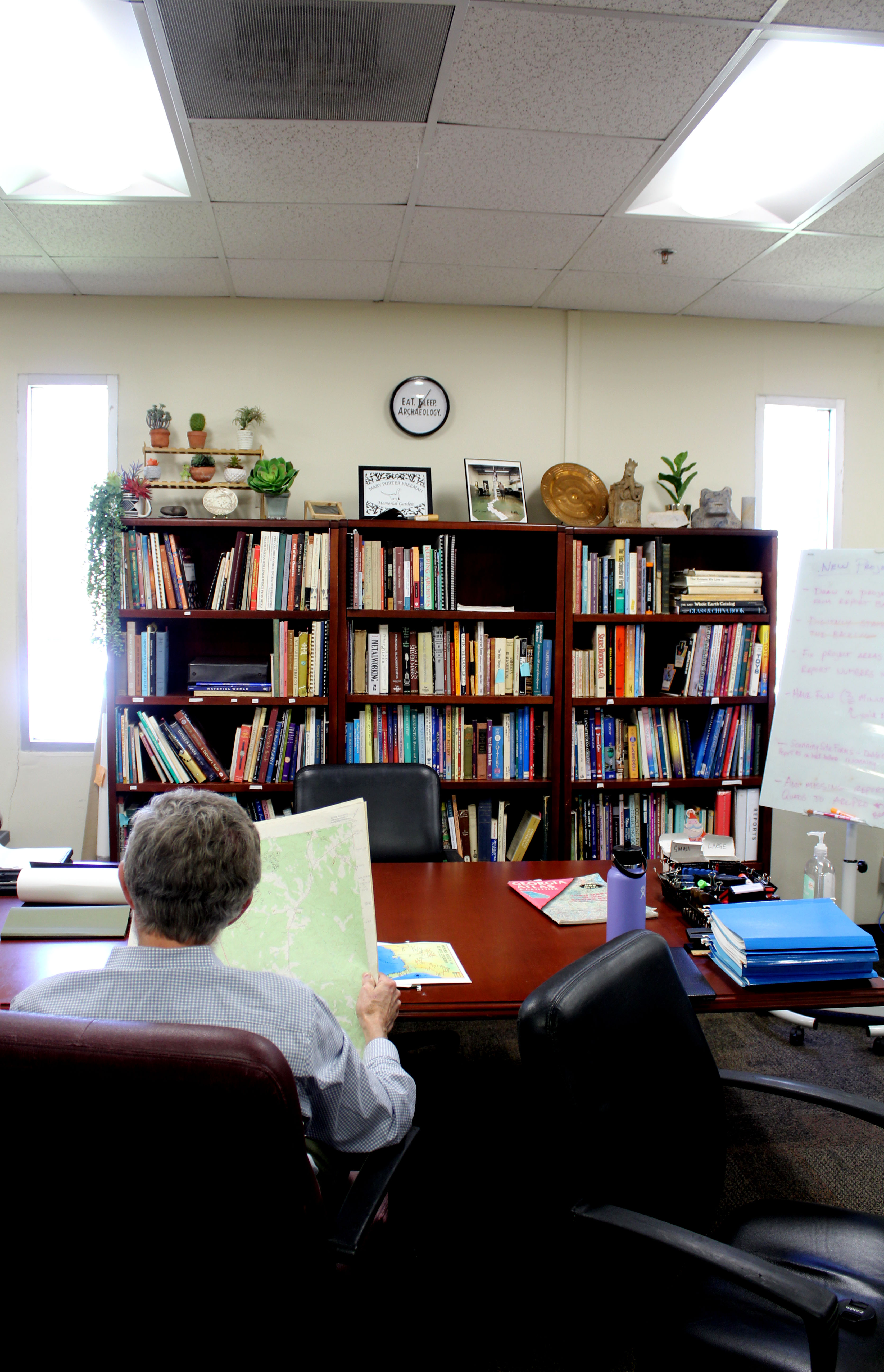
“As you probably are realizing, the reason we have sites is that some archeologists went out and looked for them, or occasionally a citizen reports one,” Gresham said, pointing to detailed site maps housed in the Georgia Archaeological Site File at the University of Georgia’s Archaeological Laboratory in Athens. “So each of these are individual archeological sites, virtually all of them Indian sites, either places they lived or maybe where they just stopped and chipped an arrowhead for a few minutes. But something’s going on.”
Gresham, who has spent two decades studying Georgia’s Indigenous history, said Native Americans inhabited the region for more than 12,000 years.
The Cherokee, who spoke an Iroquoian language, migrated into what is now Georgia from areas in what is present-day North Carolina, Tennessee and Virginia, around the 1600s.
The Creek had arrived earlier, gradually moving into Georgia from what is now Alabama and Mississippi, between the 11th and 12th centuries.
“(The Mississippian period) was a very evolved state of social interaction,” he said. “Not just nomadic hunters and gatherers, but agriculture and the chiefdom level of social organization.”
Debunking Cherokee Corner
One of the most well-known Indigenous landmarks in Oglethorpe County is Cherokee Corner, a site long believed to be an important meeting place between the Cherokee and Creek tribes.
But Gresham’s research challenges this widely held belief.
Those beliefs, including interactions between Native Americans and settlers, were detailed in Florrie C. Smith’s book “History of Oglethorpe County.”
Smith described Cherokee Corner as a central meeting location between different tribes. In fact, Smith writes that the name Cherokee Corner was given based on the result of a game played by the Creek and Cherokee tribes.
When deciding on divisions between native and settler land in the late 1700s, Smith wrote the natives refused to cede land at Cherokee Corner beyond a chestnut tree near where Cherokee Corner Church stands today.
“Cherokee Indians had for two days been protesting to the United States surveyors that they were going beyond the line agreed upon,” Smith wrote. “On the second day of their complaint after the noon lunch, the old chief walked up to the above tree and cut a cross mark upon it, saying with a show of feeling, ‘Here we stop. We go no (further).’”
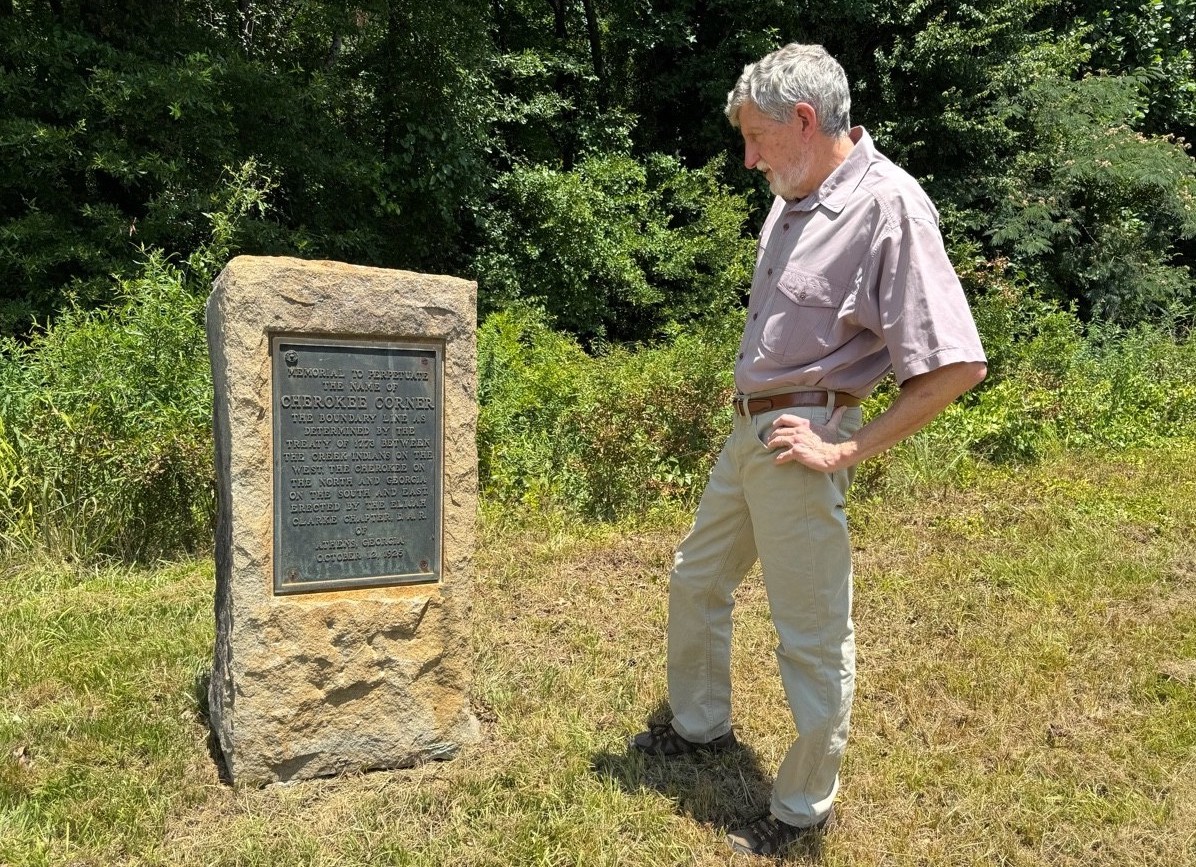
After Native Americans were removed from the area in the early 19th century, Cherokee Corner became a trading spot for settlers. A marker originally erected in 1925 is about 150 yards west of Cherokee Corner church, on the north side of Highway 78.
“There is a mythology or stories about Cherokee Corner, how it was a great meeting ground, and great councils, Indian councils, and the Creeks and the Cherokees met there and played games,” Gresham said. “All that's not true at all.”
During an archaeological survey, Gresham identified two sites in the Cherokee Corner area, but found no evidence of settlements dating to the Mississippian period, reinforcing that it was a “no man’s land.”
Rather than a gathering place, Cherokee Corner served as a buffer zone between the Cherokee, who lived farther north, and the Creek, with both groups using the land primarily as hunting grounds.
Gresham’s findings, based on extensive archaeological surveys conducted by other researchers in Oglethorpe County during the late 1980s and around 2010, come from detailed reports, ranging from 100-300 pages, at the Georgia Archaeological Site File. These findings led him to conclude that the tribes “interacted very rarely” in the area.
Discovering a new culture
Instead, the real traces of Native American presence are in other parts of the county, where artifacts suggest a unique cultural fusion between the Creek and Cherokee.
“The history of Indians in Oglethorpe County really is no different than almost anywhere else in Georgia until you get to the most recent Indian period,” Gresham said. “And that’s where we really become unique with this Wolfskin culture that we have here.”
Rather than densely populated settlements along major rivers, the excavated archaeological site became home to what is called the Barrow Creek site, a network of small, scattered farmsteads that emerged after European contact, likely as Indigenous groups adapted to the pressures of colonization.
The site is situated on a ridge east of Barrow Creek and north of Hutchins-Wolfskin Road. It later became the type site of the Wolfskin culture, sometimes referred to simply as the Wolfskin type site.
“What we are theorizing happened is somewhat unique to Oglethorpe, Madison, Jackson, a little bit of Oconee County, is this,” Gresham said. “It’s now called the Wolfskin culture, based on the Wolfskin area of Oglethorpe County, that these Mississippian-period Indians abandoned the villages, abandoned the mound sites and lived in isolated farmsteads all over out in the country.”
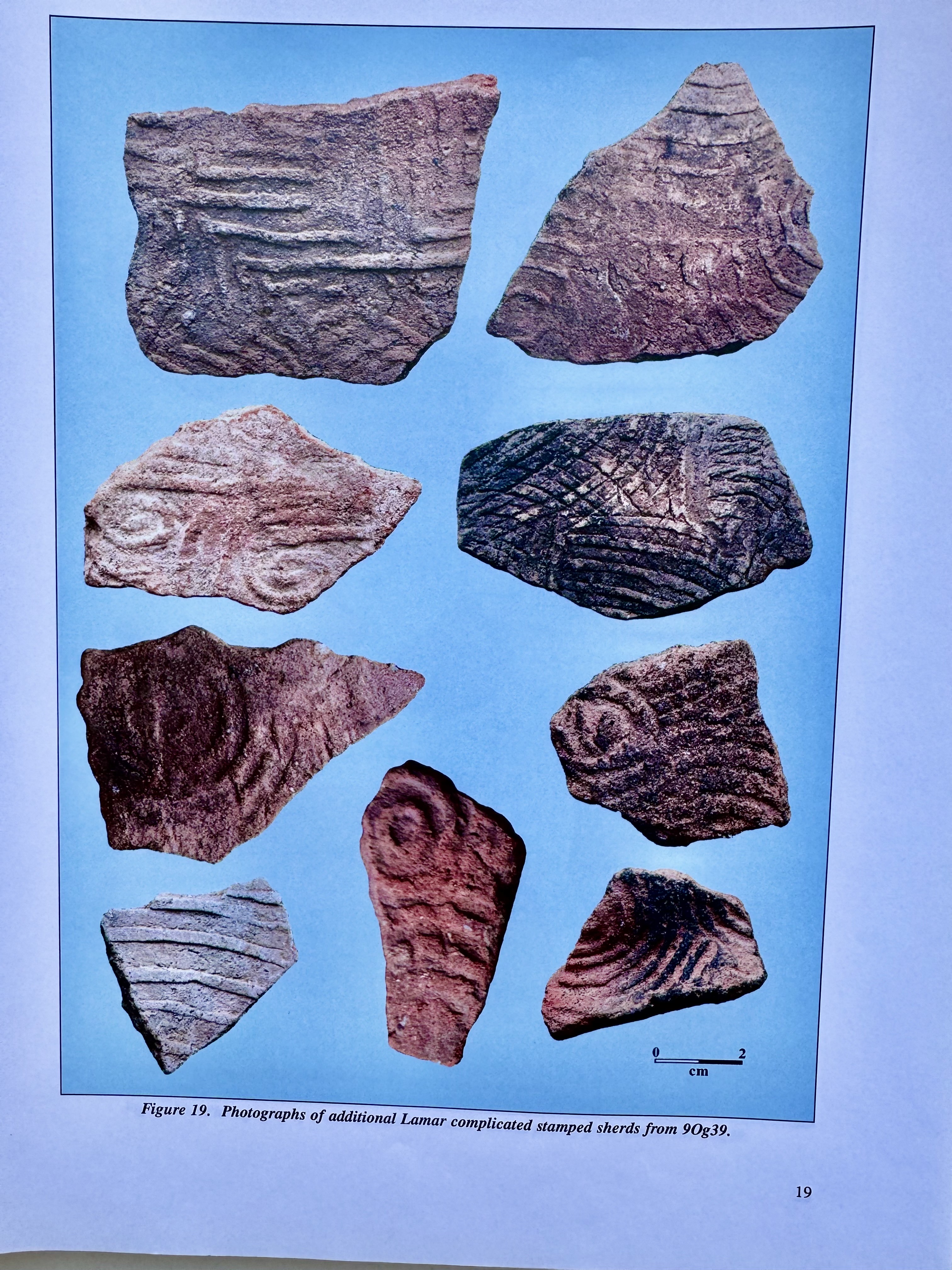
The site contained Wolfskin culture pottery, marked by an “unusual set of pottery types,” with punctate and carved designs not previously documented in the region.
Although the boundaries of the Wolfskin culture are not firmly established, it appears to extend from the Oconee River to the Broad River, covering nearly all of Oglethorpe County, most of Madison and Jackson counties, and parts of Oconee and Elbert counties.
While its full significance is still unclear, Gresham said the culture is “almost certainly” a blend of Creek and Cherokee influences.
“It’s a little hard to know whether it’s just cultural things, or is it literally people of Cherokee blood and Creek blood intermingling and creating new settlements,” he said. “You know, this was a lot of warfare.”
Beyond its distinctive pottery, the defining characteristic of the Wolfskin culture was the presence of scattered farmsteads on nearly every hill.
“Again, probably where a family lived, some people theorize they lived there 10, 15 or 20 years, and then the house got so bug-infested and fallen, they just would move to the next hill over that wasn’t occupied,” Gresham said.
Gresham described the Wolfskin culture as a form of “urban flight” — a survival strategy in which people moved away from large, vulnerable settlements. This shift may have been driven by the need to avoid attacks or the difficulty of sustaining enough agriculture to support a sizable village.
Gresham’s research on the Wolfskin culture is scheduled to be published in the journal “Early Georgia,” by the Society for Georgia Archaeology this year.
“So yeah, (the Wolfskin culture discovery) was in the 1980s,” Gresham said. “And it took a while to … when you discover something new, you don’t know, ‘Was this just a minor, little weird thing, or is it really something big?’ And I'm beginning to realize it’s a big deal.”
Bridging the past
Beyond the archaeological sites and historical records, Oglethorpe County is home to Native American descendants.
Census records indicate that between 50-60 residents identify as Native American. Gresham said their stories could provide a crucial link between the archaeological past and the history of Indigenous people in the region.
UGA actively invites Creek and Cherokee representatives from Oklahoma and North Carolina for consultations, fostering collaboration between archaeologists and Indigenous communities.
“The University of Georgia is very good at reaching out,” Gresham said. “And scientists sort of poo-poo oral history, but there’s a lot to it. I mean, as we know, on any subject, you hear folk tales, and you just don’t know whether to believe or not. But often, there’s usually something to it.”
Tell your stories
The Oglethorpe Echo seeks Native American residents of Oglethorpe County willing to share their stories to gather more information on Native American history and culture around the county. Please email editor@oglethorpeecho.com