
Water issues continue to plague Oglethorpe

The Oglethorpe Echo
Residents continue to raise concerns over water quality issues in Oglethorpe County. As Crawford still deals with brown water, recent test results in Lexington detected uranium levels that exceed drinking water standards in one of its five city wells.
Lexington city clerk Kim Bradford said this isn’t the first time there’s been a uranium issue.
Test results in July of 2023 prompted initial concerns about elevated uranium levels in the well at Centerville, and the newest round of tests from January revealed a spike in uranium levels over the past year.
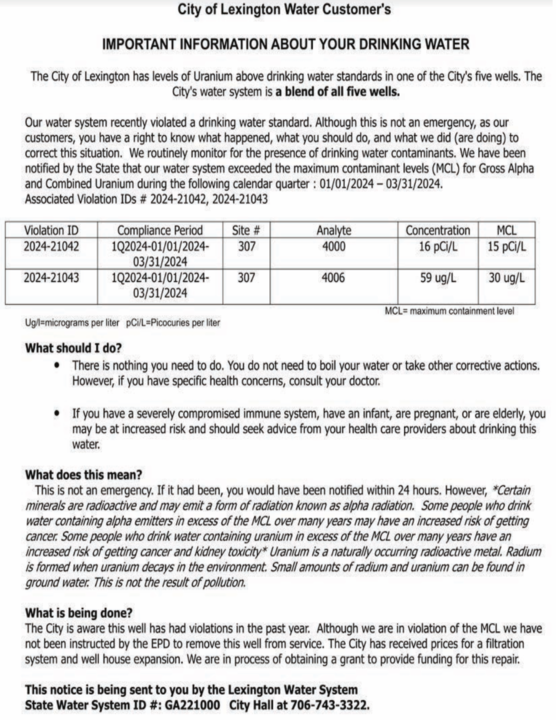
“This well has had the same uranium issue for a while, so this violation isn’t anything new to us,” Bradford said.
The Georgia Department of Public Health states most uranium in drinking water is quickly eliminated from the body. However, long-term exposure to elevated levels can damage kidneys.
“The only thing that would be of concern is drinking water,” District 5 Commissioner Tracy Norman said. “You can bathe in it. You can wash clothes in it. You can water your garden with it. It's not going to hurt you.”
In the past, a well showing high uranium levels was immediately taken out of service. This time, the state Environmental Protection Division (EPD) has not mandated removal of the well.
“It’s just barely over,” Bradford said. “If it had been an emergency for us to take it out, they would have definitely notified us.”
Lexington alerted residents about elevated uranium levels in one of the city’s five wells in an ad published in last week’s edition of The Oglethorpe Echo. The notice indicates that the test results do not constitute an emergency and no precautionary measures are necessary.
While the well is not a primary water source, producing roughly 30 gallons per minute and mainly used for chlorination, city officials said they are committed to resolving the issue.
Water superintendent Adam Boswell is collaborating with the Georgia Rural Water Association to do so. The city applied for a $70,000 grant in December 2023 to cover the costs of a new filtration system. It hopes to hear back about the grant’s approval by December.
In the meantime, Boswell said the water remains generally safe.
“I drink it, I live,” Boswell said. “I don’t have a problem with it.”
Local officials point out that uranium is a natural part of Georgia’s waterways, especially in areas with a lot of granite.
“You’re never going to get rid of all of it because it’s just part of the environment,” Norman said.
For Oglethorpe County residents using private wells, Norman encourages anyone concerned to contact the county’s extension service.
“If you have a private well and you have a high radium or uranium level, what you can do is use a reverse osmosis filter in your house, and that will remove usually 90-95% of the uranium or radium,” Norman said.
While Lexington officials work on addressing the uranium spike, Crawford continues to deal with issues of brown water.
“We've had some brown water issues in Crawford, but that's because of various issues,” said Donny Faust, lead operator at Crawford Water Department.
The Crawford City Council approved the purchase of a $16,500 aerator in July to improve oxygen levels and combat the brown water issue.
“The aerator has been ordered, but it has not been installed yet,” Faust said.
Faust said Crawford residents can expect the aerator to be installed by early September or early October.
Faust added that each city in Oglethorpe County manages its own water system. While Crawford faces issues like brown water, uranium contamination does not pose a concern.
“We (Crawford) don’t have any problems with uranium,” Faust said.