
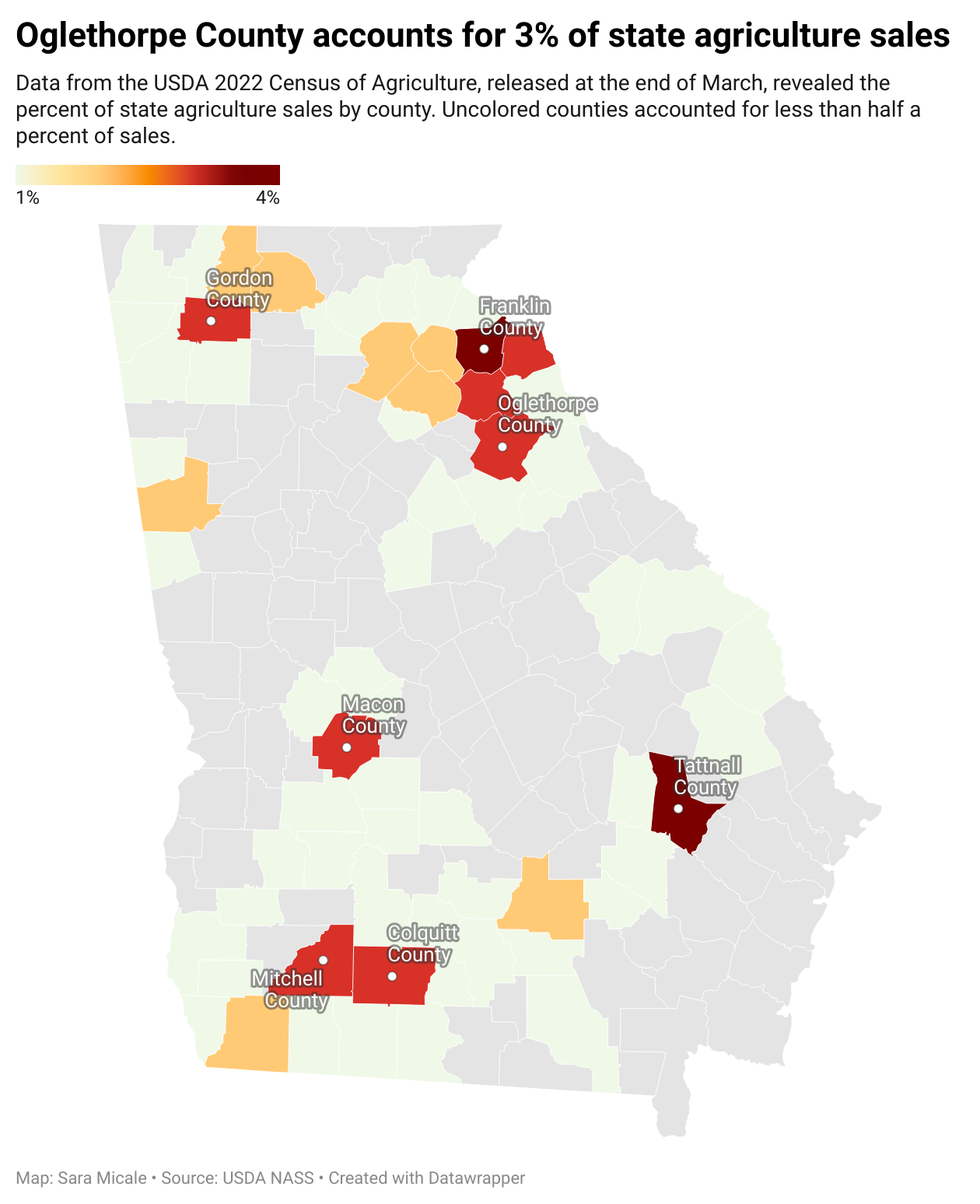
Farming in Oglethorpe County has grown in the past five years despite a national and statewide decrease in the number of farms.
Oglethorpe County’s 2022 Census of Agriculture County Profile saw significant increases in number and average size of farms and net cash income. The county accounted for 3% of total state agricultural sales, which is a 1% increase from the 2017 census.
Overall the county is first in the state for market value of hogs and pigs.
The USDA National Agricultural Statistics Service (NASS) released its 2022 Census of Agriculture County Profiles at the end of March, with the statewide census having been released in February.
The census is conducted every five years and the data covers from 2017 to 2022. The NASS reports a 61% national response rate.
“Through the Census of Agriculture, producers can show the nation the value and importance of agriculture and can influence decisions that will shape the future of U.S. agriculture,” according to the USDA website.
What’s increased?
- The number of farms in Oglethorpe County rose 3%, from 427 to 438.
- The average size of a farm in acres is 183, a 7% increase from 171 acres in 2017.
- Total market value of products sold is up 105%, from $198.4 million to $407.4 million.
- Farm-related income rose from $1.65 million in 2017 to $3.47 million, a 110% increase.
- Total net cash farm income also rose from $76,409,000 to $176,325,000, a 131% increase from 2017.
- Land use practices have increased from 4% of farms using no till to 9%. Reduced till farms have also increased from 2% to 6%.
Reduced tilling is a type of conservation tillage, which prevents soil erosion and water runoff, and also promotes healthy soil biology, according to Stanford University’s Doerr School of Sustainability.
In previous reporting for The Oglethorpe Echo, Comer farmers Ben and Dale Brubaker said they limit tillage on their property, where they grow corn and soybeans.
“We’re switching more to a non-tilling type of farming,” Dale said. “More of a conservation approach than your traditional get out and really till the soil up every year.”
“We don’t want anything eroding because it takes thousands of years to get that topsoil, if it erodes,” Ben said.
What’s decreased?
- Intensive till land use has decreased from 3% of farms to 2%.
- Share of agriculture sales from crops has decreased from 7% to 5%, in comparison to livestock, poultry and products.
- Organic farms have decreased from 1% to less than half of a percent.
- Family farms have decreased from 98% to 95%.
Poultry farmers Gabriel Jimenez and Tamita Brown from Caribe United Farm in Crawford told The Echo in previous reporting that several small local farms have been forced to shut down due to high demands and long hours.
Ben Brubaker attributes the fall of family farms to expenses, among other factors.
“Once the old guys, so to speak, got out years ago, it is too cost prohibitive for the younger generation to get back in,” he said.
The decrease in organic farms may be due to the difficulty of becoming certified organic by the USDA.
“It is a very expensive and tedious process to obtain that (organic farm) certification,” UGA County Extension Coordinator Shanna Reynolds said.
What’s stayed the same?
- Eleven percent of farms have cover crops as a land use practice.
- Farms with over 1,000 acres account for 3% of farms in Oglethorpe County.
- Oglethorpe County maintained its No. 1 rank in the state for market value of hogs and pigs.
National and statewide changes
- Nationally, the number of farms is down 7% from 2.04 million to 1.9 million. The number of farms in Georgia decreased from 42,439 to 39,264.