
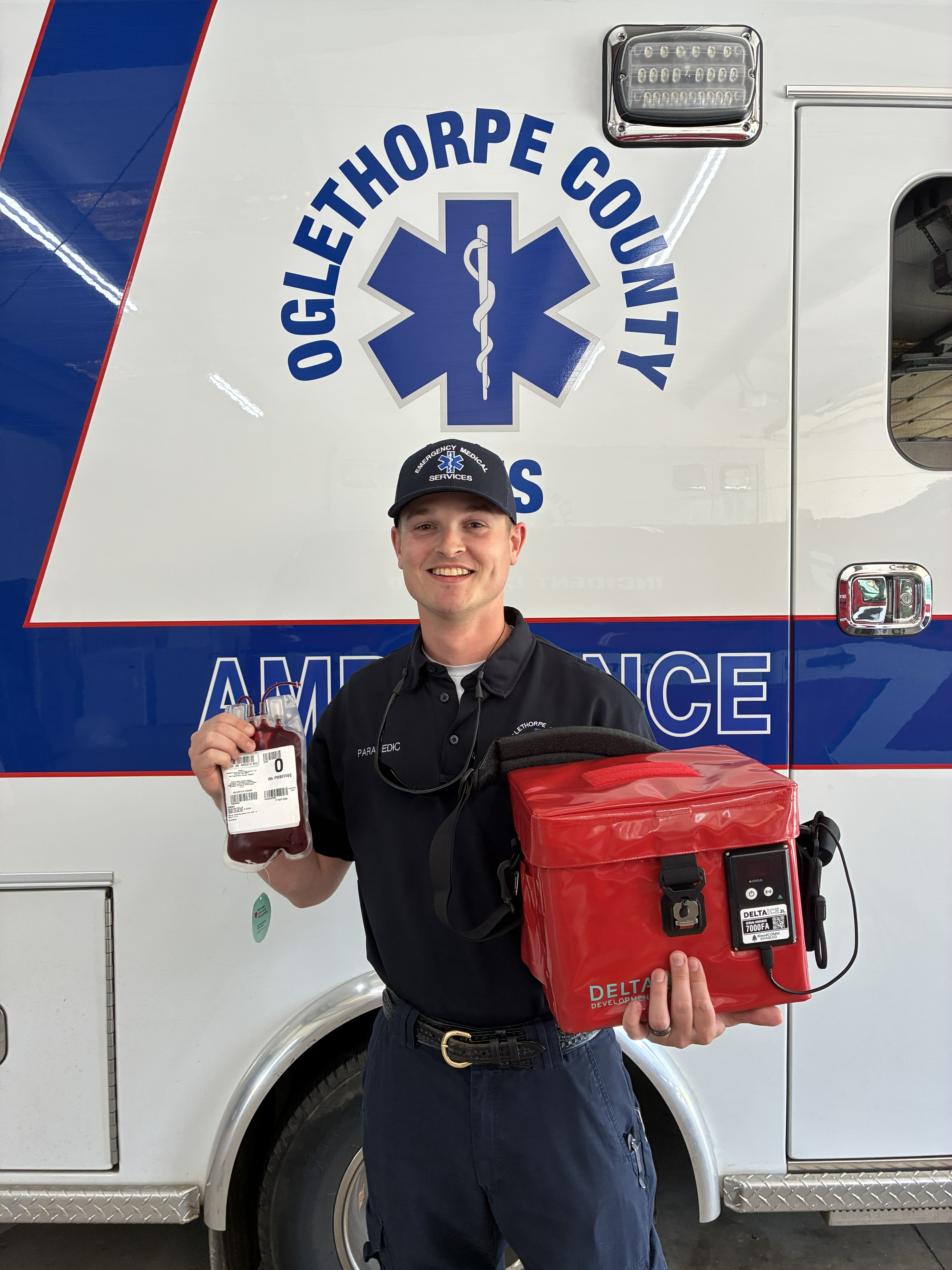
Supervisor paramedic Dylan Smith holds a bag of whole blood product after Oglethorpe County EMS was approved to start the program on Aug. 11. Being able to offer whole blood has been a goal of EMS director Josh Robinson. (Submitted Photo)
Oglethorpe County EMS has achieved a long-term goal of offering whole blood products, giving paramedics another tool to potentially save lives before patients reach a hospital.
The program went live on Aug. 11 after a year-long process of securing funding and equipment, establishing a blood supply and completing the required training and state approvals.
“The overall hope with it is that it helps our patients and increases their chance of survival, and shows that we’re doing everything we can for our patients when we have to transport them,” EMS director Josh Robinson said.
For patients experiencing significant blood loss, having access to blood products in the field changes what paramedics can do during transport.
Supervisor paramedic Dylan Smith said EMS previously relied on fluids, such as saline, to help stabilize trauma patients who were losing blood. Unlike blood, however, saline doesn’t carry oxygen to the body’s tissues, and administering too much can be detrimental to a bleeding patient.
“Instead of having to try to give a little bit of fluid and just try to keep their blood pressure stable enough to keep them alive until we get them to the OR, now we can just replace the volume that they’re losing with what’s natural in our bodies,” Smith said. “There’s less to worry about as far as doing something that’s detrimental to your patient that’s bleeding out.”
According to the National Institute of Health, trauma-related injuries are the leading cause of death for Americans between the ages of 1 and 46, resulting in 60,000 deaths each year in the U.S. Research has also found that administering whole blood products during prehospital treatment can improve survival for patients experiencing extreme blood loss.
The ability to begin that treatment before reaching a hospital is especially important in rural settings like Oglethorpe County, where the nearest hospital can be more than 20 miles away.
Whole blood products can also be used for more than traumatic injuries. Smith said they can benefit patients experiencing medical emergencies such as gastrointestinal bleeding, which is often seen in elderly patients.
“It's been amazing (to have whole blood),” Smith said. “There's been a couple of counties in the state of Georgia doing it. It’s such a great tool. It’s a great resource to have, and it’s gonna benefit a lot of people,” Smith said.
The program has been a goal for Robinson since he took over as EMS director in April 2025, building on groundwork started under former director Jason Lewis. Over the past year, EMS has pursued funding for the program, established partnerships for its blood supply, purchased specialized equipment and completed the required post-licensure training.
The effort initially called for a collaboration through the Regional Trauma Advisory Council and Piedmont, but Robinson said logistical issues caused the plan to fall through.
EMS established an agreement with Augusta-based Shepeard Community Blood Center to supply its blood products. Oglethorpe EMS has also partnered with neighboring departments in Madison and Elbert counties to share storage at a central location so that each county’s EMS services can easily access blood supply refills.
Oglethorpe EMS paramedics also had to complete post-licensure certification for prehospital blood administration. The final piece was the arrival of the specialized cooler needed to safely store the blood.
Smith said the training included online instruction covering different blood components, proper storage and handling and the circumstances in which blood should be administered. Paramedics then received hands-on training with the new equipment they would use in the field.
The program cost about $15,000 to start, Robinson said. That included the blood warmer, administration sets, cooler, blood products and the software used to monitor blood temperature.
The county initially used money from its general budget for the program, but the Georgia Trauma Commissioner’s Trauma Equipment Grant will help reimburse some of those costs. Robinson training said the commission is also working to make additional funding available to EMS agencies that have or want to establish prehospital blood programs.
EMS expects to receive new blood products about once a month. Robinson said one bag of plasma costs $75, while one bag of packed red cells costs $375.
Packed red cells nearing the end of their shelf life can be returned to Shepeard and placed back into circulation rather than going unused. EMS is not charged for those units until they are used.
The partnership with Shepeard also gives Oglethorpe County residents an opportunity to directly support the program through local blood drives.
“It's basically a community blood center, and what that means is that the blood that is donated in the county when Shepeard comes up here to do blood drives has a good chance of coming right back to us on our ambulance, and so it could be a community member’s blood that’s helping one of their family, friends and neighbors,” Robinson said.
Shepeard is also partnering with Oglethorpe County High School for blood drives. Robinson said students who donate up to three times while in high school can earn a cord to wear at graduation through the center's High School Heroes Program.
A community blood drive is tentatively scheduled for Nov. 20, with additional information expected closer to the event. Robinson said the high school's blood drives will also be open to community participation.
“The community can help us tremendously by coming out and donating blood,” Robinson said.
Sarah Owens is a master’s student in journalism at the University of Georgia.