
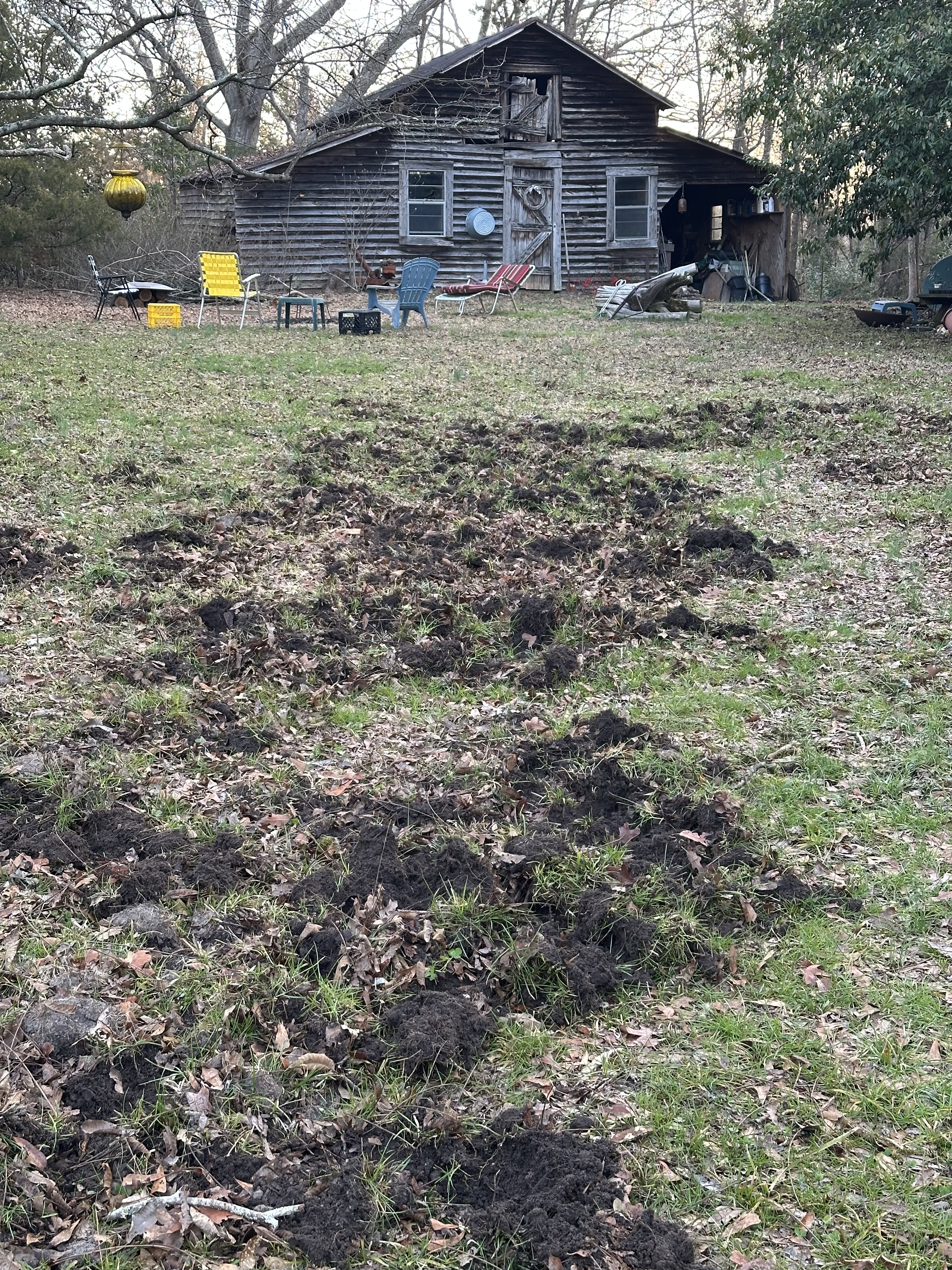

Rebecca Wood trudged through her yard late last month to inspect her uprooted grass. She pointed to her beloved flower bed, home to tall, blooming perennials and annuals, and let out an aggravated sigh.
“It’s just like a rototiller went through there,” Wood said. “I’m super pissed off about that.”
Wood’s yard in downtown Lexington had fallen victim to six wild hogs rooting for over a week, single-handedly causing hundreds of dollars in damage.
She doesn’t think it’ll stop there.
“If they’re just on a relentless march, it’s into the historic district,” Wood said. “They’re gonna be messing up everybody’s lawn over there, too.”
The website Georgia Feral Swine identifies wild hogs as “any hog which has lived any part of its life in a wild, free-ranging state.”
Hogs inhabit up to 80% of Oglethorpe County, and according to Oglethorpe County game warden Phillip Nelson, there are more than ever before.
He said he believes this is due to the legalization of baiting, which is the ability to hunt over or near food with no distance requirement.
“(The wild pigs) always have food if people are running feeders year round, so they don’t really have to leave to find food,” Nelson said. “So, if you’re feeding them, then they’re gonna stay.”
Nelson describes wild hogs as just a “loud” and “destructive” invasive species and said farmers “can’t stand them.” Wild hogs root in the ground to find food, using snouts and hooves to dig up anything from earthworms to vegetables.
This behavior often damages farmland, backyards and wildlife habitats.
According to a report by the Georgia Department of Agriculture, wild hogs can also destroy fence lines and gorge themselves on feed, which can take food from livestock and spread disease. In some cases, small or young livestock can become prey for the pigs as well.
In addition to effects on livestock and agricultural areas, the report said wild pigs damage natural environmental areas and compete with other wildlife for food sources and habitat.
“A pig will eat. That’s all it does,” said Bobby Butler, a year-round wild hog trapper based in Oconee County. “That’s its life, walk, eat and reproduce.”
Female pigs, also known as sows, can have two litters of up to 12 piglets every year. Nelson argues that because of the rapid reproduction rate and the lack of natural predators, population control falls on hunters.
Nelson recommended shooting the pigs, and Wood said her neighbors advised the same. But it’s illegal to shoot within the Lexington city limits, according to former city councilman Greg Reece.
The Georgia Department of Agriculture states that shooting wild hogs is effective in driving pigs away from an area, but it’s only a temporary measure.
Baiting wild pigs with soured corn or fruit jelly and then trapping them remains the most effective form of population control, according to the GDA, but this method requires more skill than shooting. Wild pigs are intelligent, which means they will learn to avoid future traps.
Some turn to professionals, such as Butler, for help. Butler has been trapping and hunting hogs since he was in high school, and now at age 56, he serves as an on-call trapper year-round in Oconee, Greene, Walton, Morgan, Clarke, Madison, Oglethorpe and Barrow counties.
Butler uses traps that range in price from $500 to $18,000, and each time he deploys a trap, it costs the customer $600. The contraptions can trap over 20 pigs at once.
Butler said all the pigs he traps are killed on-site because it is illegal to release feral swine into any area that is not fenced to prevent escape.
“It’s good meat if you properly clean it, wash it, keep it cold — it’s good meat,” Butler said. “It’s all organic. It’s not getting any chemicals, no shots, nothing.”
He said as “long as you’re doing something,” it will help the issues that arise with wild pigs.
“If you’re not doing anything, you’re not getting anywhere,” Butler said. “Pigs are kind of opportunists.”
Wood said she hopes the pig problem is resolved soon in Oglethorpe County’s residential areas.
“We’ve got to find some way to get rid of them,” Wood said. “They’ve already done hundreds of dollars of damage. I don’t want to pay hundreds to get rid of them.”