
County’s 12 stations collaborate despite organizational differences
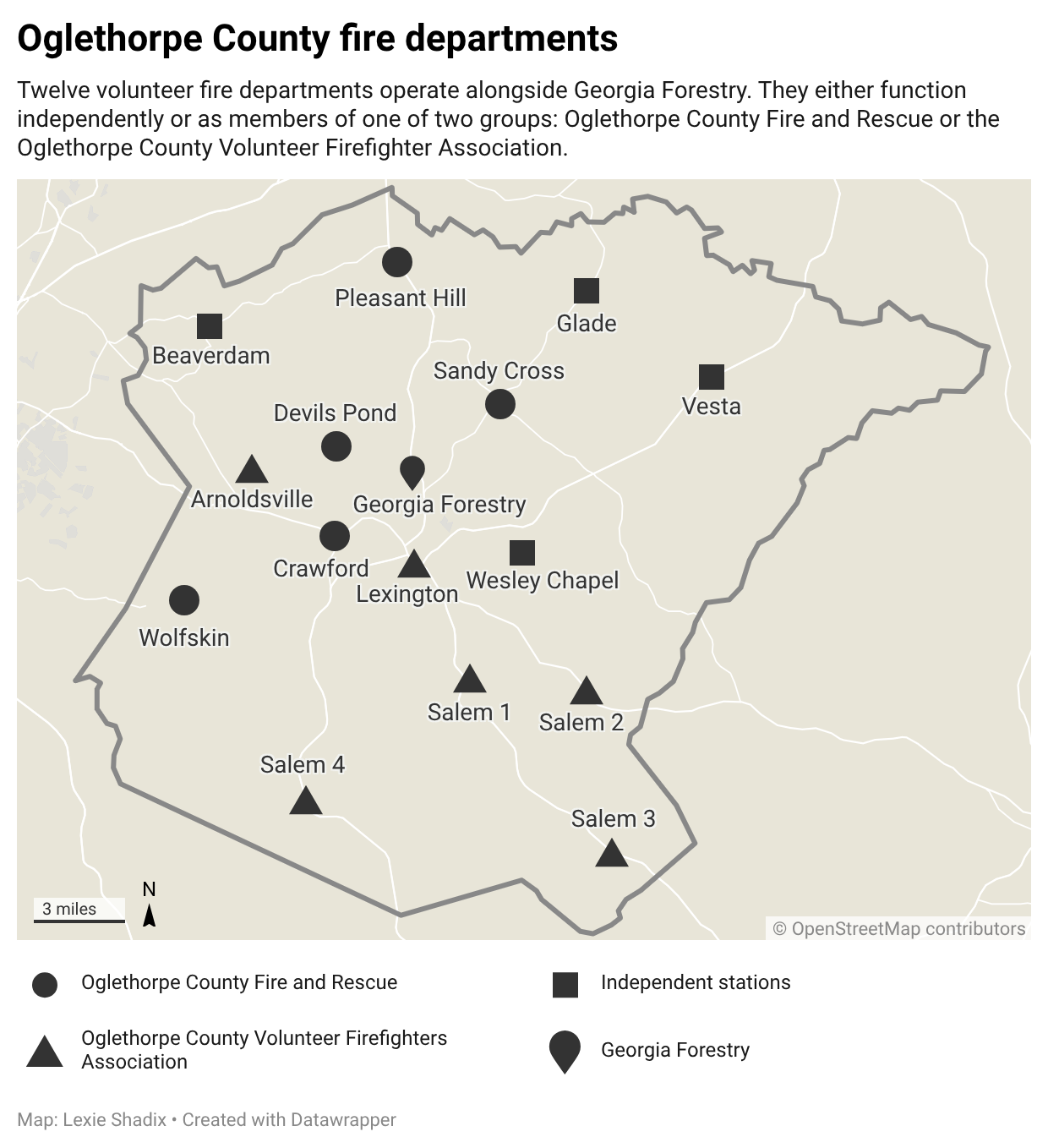
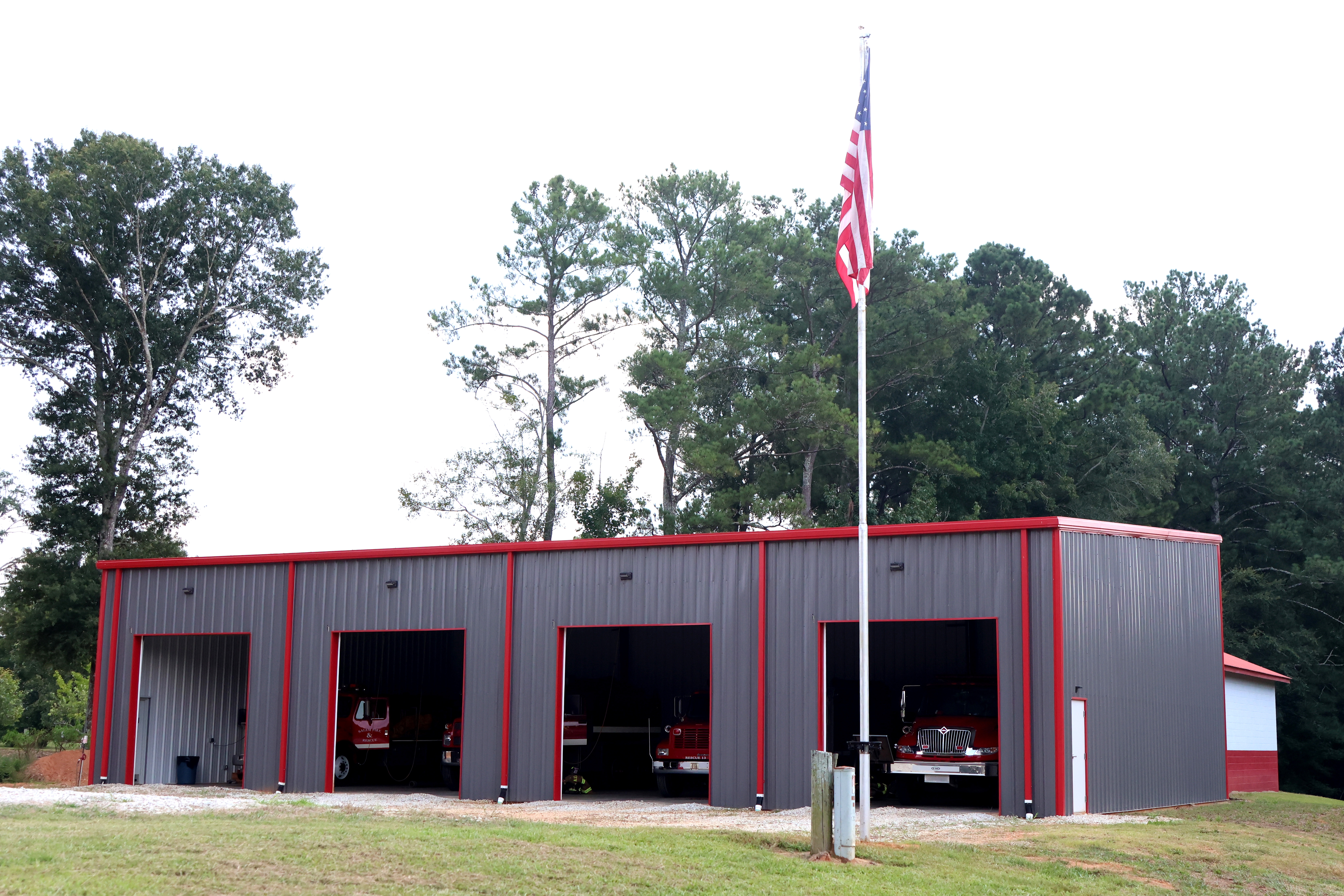
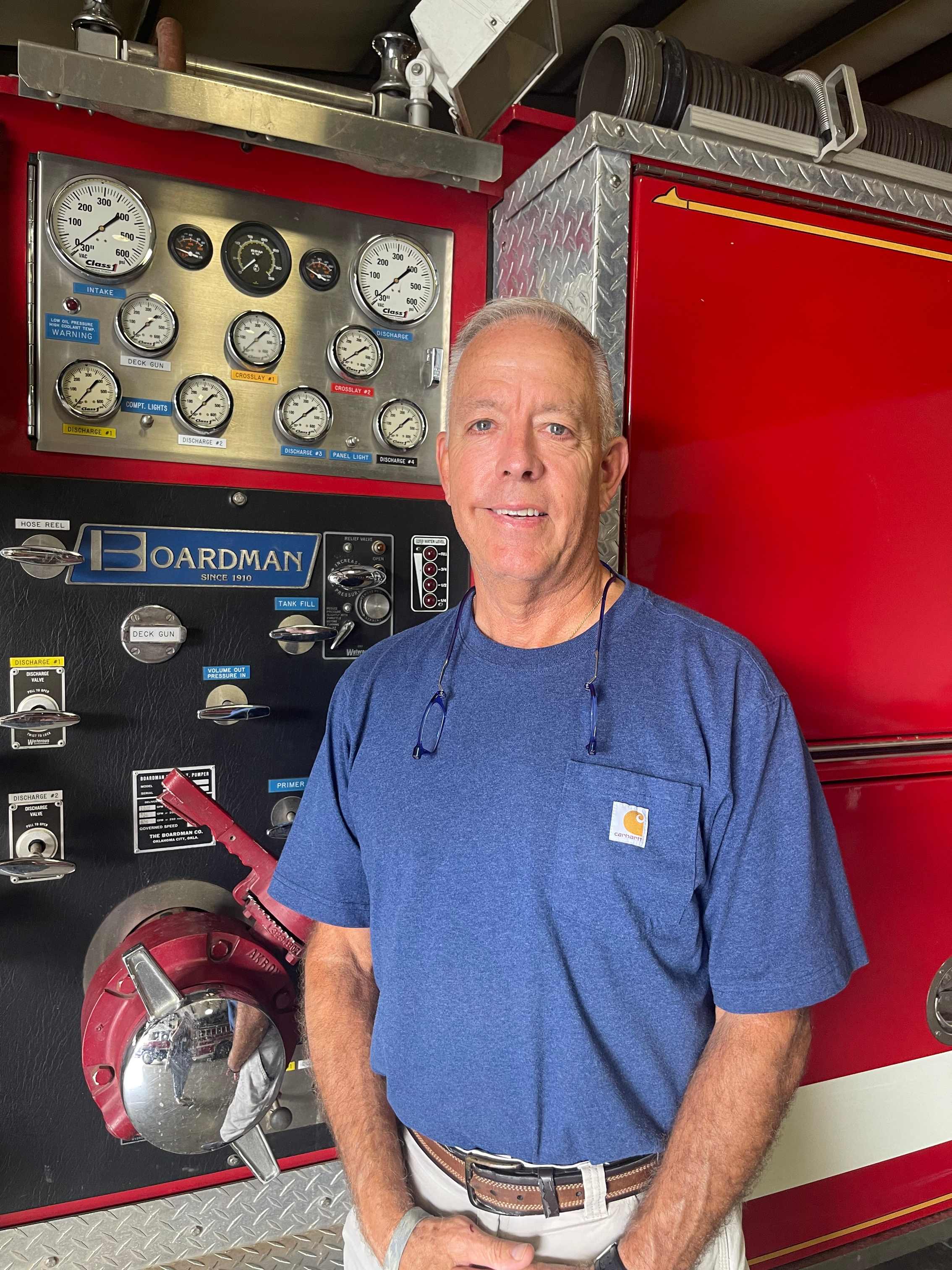
Rocky Miller, the chief of Oglethorpe County Fire and Rescue (OCFR), stands in front of a truck at the Crawford Volunteer Fire Department. OCFR is one of the consolidated groups of fire departments, consisting of the Crawford, Sandy Cross, Devils Pond, Pleasant Hill and Wolfskin stations. (Lexie Shadix/The Oglethorpe Echo)
Ethan Thaxton, the deputy chief at Salem Fire and Rescue, recently joined the roster of Crawford Volunteer Fire Department. While Thaxton lives near one of Salem’s stations, he works in Crawford, leading him to offer support to its team.
Details are still being finalized, but Thaxton hopes the change will allow him to assist the department when his work schedule permits.
“I figure when I can turn loose from my job, I could give some help to them,” Thaxton said.
Across Oglethorpe County, 12 entirely volunteer fire departments provide fire services to the community. They work alongside the Georgia Forestry Commission, a state organization that prevents and suppresses wildfires and assists rural fire departments. Beyond sharing rosters, the volunteer fire departments routinely open their training to one another throughout the year, covering topics like extrication and hazmat response.
“Most all of the stations in the county at some point trained together,” Devils Pond Chief Stanley Grimes said. “There’s real brotherhood and sisterhood in the fire department here in the county.”
When an emergency call comes in, the closest two or three stations are typically dispatched, requiring firefighters from different departments to work together on the scene.
While departments collaborate closely in the field, they face organizational differences. Each department is either independent or a member of one of two consolidated groups: Oglethorpe County Fire and Rescue (OCFR) or the Oglethorpe County Volunteer Firefighters Association.
At one time, all the departments in the county belonged to the Volunteer Firefighters Association. Members would pay dues, elect leadership and present funding requests jointly to the county.
Today, only three departments remain: Salem, Arnoldsville and Lexington. Membership declined when OCFR was established in 2016, and dwindled more when two of the association departments — Philomath and Maxeys — merged with Salem in 2021 and 2023, becoming two stations of the Salem department.
OCFR, an idea of Emergency Management Agency director Douglas Spencer, was designed to unify the county’s fire services after new state regulations were placed on volunteer departments in 2016. Many of the smaller departments like Vesta had trouble meeting these standards, especially when it came to manpower, since association members were still legally independent.
“Instead of Vesta having four people, if you put Vesta and Wesley Chapel and Pleasant Hill together, well now you’ve got 15 people, and the state’s like … ‘that’s a good department,’” Spencer said.
OCFR consists of five stations: Crawford, Devils Pond, Wolfskin, Sandy Cross and Pleasant Hill, and has an estimated 40 volunteers and 12 trucks. Unlike the association, it is legally one department and a 501(c)(3) nonprofit organization.
OCFR is led by chief Rocky Miller, safety chief Matt Bradshaw and deputy chief Lou Manglass, who is also the acting chief of Wolfskin.
Despite this overarching leadership, each station maintains some autonomy. They have individual chiefs that meet regularly with Miller, Bradshaw and Manglass to discuss fire reports and potential improvements, and have their own rosters.
The stations also retain some financial independence, meaning they can petition the county for funds individually, and if they take out a loan, the financial obligation is tied strictly to that station, not the broader organization.
The county’s remaining stations — Glade, Vesta, Wesley Chapel and Beaverdam — operate independently after leaving OCFR.
Glade and Vesta left in 2022 due to leadership issues, followed by Wesley Chapel in 2023 to increase membership and grant funding, and Beaverdam in 2024 to lower its Insurance Services Office (ISO) rating.
While collaboration is encouraged, there is no active effort to force complete consolidation, and debate surrounding this is ongoing. Full integration can present a challenge, particularly when it comes to grant funding and ISO ratings.
As a consolidated group, OCFR stations share one Fire Department Identifier, and must apply for many grants collectively. Sandy Cross chief Kelly Huff said one of the biggest challenges his department faces is the lack of grant opportunities available to it, since it can’t apply separately.
“If there was anything I could change, it would definitely be that we would like to seek the opportunity to write FEMA grants (and) Fireworks Tax Grants, and we lose that opportunity as an individual station being a part of the consolidated,” Huff said.
Despite being independent from the county, the departments receive funding from the county’s general fund and SPLOST revenue. Last year, the departments received $367,777 from the general fund, and are budgeted to receive up to 13.05% of SPLOST funds on a yearly basis.
“They’re not county departments, so the county has little governance over them, but a pretty close partnership with them,” county administrator Jason Lewis said.
The Crawford station recently spent $57,693 to purchase updated battery power extrication tools and two sets of replacement personal protective equipment. The board of commissioners approved the use of SPLOST funds for the purchase at its July 6 meeting.
Departments also often rely on grants due to high costs of equipment.
“Prices vary a little bit depending on what you already have … but the most recent gear I bought, it cost between $5-6,000 per set,” Huff said.
Consolidation can also impact an ISO score, which represents a department’s operational readiness, infrastructure and consistency, and is one of several things considered when determining a homeowner’s insurance premiums. Scores are given on a scale of one to 10, with Class 1 being the best.
All of the OCFR stations are rated as one department, and an under-trained station can worsen the overall score.
Some stations, like Arnoldsville, did not join OCFR when it was established to avoid receiving a worse ISO rating. Chief Heath Baker said when Arnoldsville considered joining, many OCFR stations were at a nine, while Arnoldsville was at a four.
“We couldn’t very well explain to the people in our dispatch zone why their insurance was going up because we decided to join through consolidation,” Baker said.
On the other hand, stations like Wolfskin joined OCFR to improve their ISO rating. Manglass said the station was at a 9x prior to joining. Wolfskin is undergoing a re-evaluation alongside OCFR as a whole as OCFR works to update its rating.
Some, like Crawford chief Roy Allen, are in favor of full consolidation.
“If you could get everybody to play in the same sandbox and be unified, that would benefit this county tremendously,” he said. “Not just the fire departments, the citizens.”
There has been discussion surrounding establishing a paid department or paid chief position in the county, but it doesn’t have the necessary tax base to fund those positions.
“It either has to be paid by a city or paid by the county, and none of the cities nor the county have in their budgets the amount of money it would take to pay somebody to be a fire chief,” Spencer said.
While a paid department is out of financial reach, county leadership is working on establishing a clear online space for all of the volunteer fire departments as they align their websites with ADA guidelines through CivicPlus. Residents will be able to locate contact information for departments, how to volunteer and where to donate.
Despite the divide, fire leadership emphasizes that the goal of all the departments remains the same.
“No matter whether we are or we aren’t (consolidated), our common goal is the same,” Miller said. “Our common goal is to give the citizens of Oglethorpe County the very best we can give them. That’s just all there is.”