
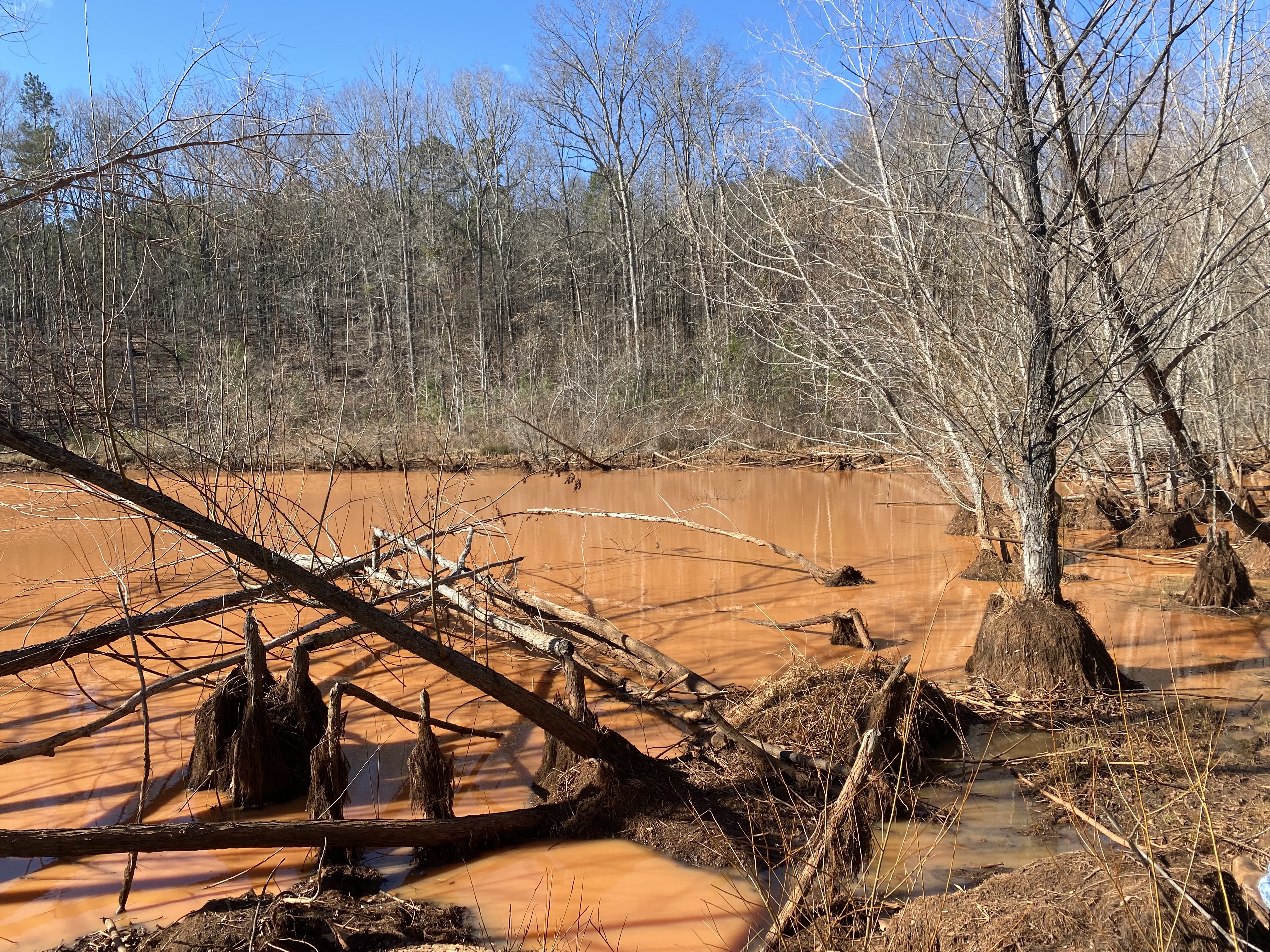
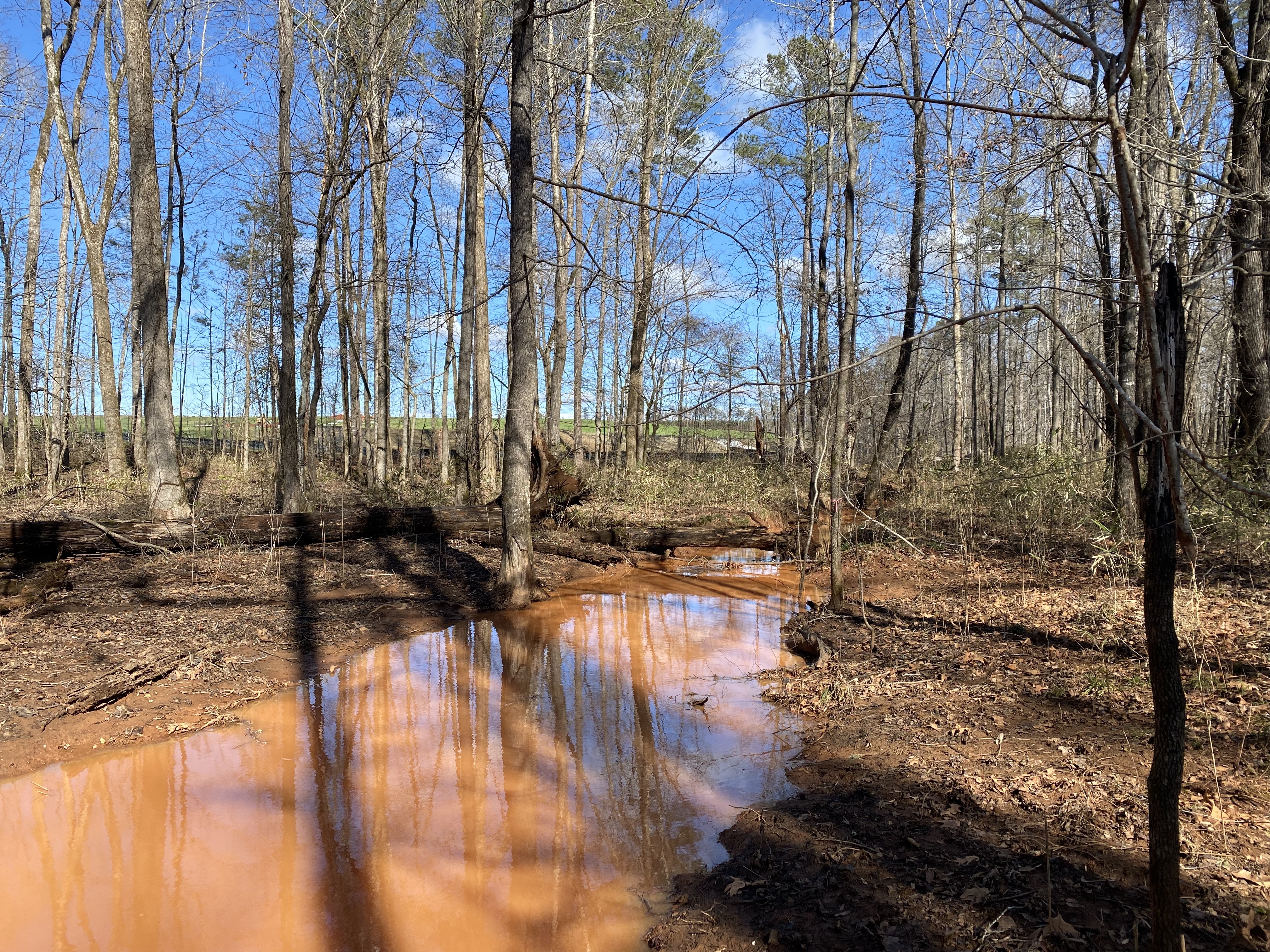
Mud threatened to swallow Jeff Sharp’s boots as he traced the side of a rust-colored creek off Goose Pond Road. Looking at the creek’s murky orange water, it wasn’t hard to see that something was wrong.
“It’s not fair to own a little piece of heaven and have this happen to it,” said Sharp, Oglethorpe County’s code compliance officer.
The “piece of heaven” Sharp referred to belongs to Joe Forrester, an Auburn, Georgia, resident who visits the property every few weeks. The property is a place of rest and recreation for Forrester, who has been going there for 18 years to hunt hogs and fish in his pond.
Now, his days of fishing in his pond may be over.
“It was a great fishing lake, but my suspicion is that all of the fish are gone now,” Forrester said. “The lake is probably ruined as far as a recreational lake.”
Forrester’s pond, like the creek that fills it, turned bright orange after heavy rains forced runoff sediment from the neighboring Timberland Solar Project into the water. Sharp and Forrester both said the solar development, owned by ConEdison, could have done more to prevent the excess runoff.
Michael Perna, the ConEdison vice president of corporate and central services, said in an email that the Timberland project is being constructed in compliance with “all applicable permits and regulations, including those governing stormwater management.” Perna added that the company will assess the need for additional action if site-specific issues arise.
All developments in Georgia disturbing over an acre of land must have stormwater discharge permits with the state Environmental Protection Division. These complex permits provide guidance and regulations with the ultimate goal of protecting water quality, said Jamie Lewis, an EPD program manager in the Northeast District Office. The permits give developers guidelines they must meet regarding erosion and sediment controls.
Developers use Best Management Practices to control erosion and stormwater runoff on their sites — these can include silt fences, soil retaining systems and stormwater detention structures, like ponds. Timberland Solar has BMPs in place, but Sharp said unfinished grating caused water to bypass Timberland’s ponds and flood the area along the property line they share with Forrester.
Sharp and Forrester are certain the runoff came from the Timberland development, but the solar project may still be in compliance with EPD guidelines. Sometimes in extreme weather, which the EPD defines as a 25-year, 24-hour rainfall event, a developer may be allowed to exceed their runoff limits, Lewis said.
“Sometimes it rains so much, there’s nothing that’s going to be able to hold back that water,” Lewis said.
He added that the nature of Piedmont soil, notorious for its red clay, makes it difficult to contain sediment. Clay particles are the smallest kind of soil particles, with diameters less than 0.002 millimeters.
“It’s almost impossible for a lot of these facilities, during a rain event, to actually meet their discharge limit, because of these fine particulates that get suspended in the water,” Lewis said.
Yet, Forrester said his lake turned “totally red” over two months ago, before the heavy rains of the last several weeks.
He said issues began when the Timberland Solar Project began clear-cutting trees, a practice which has been linked to erosion. Sharp said different components of a forest, like the tree canopy and pine needles on the ground, help slow stormwater.
He said he doesn’t know how he feels about the solar project, but he sometimes wonders about its environmental impact.
“Part of me thinks, ‘You take this beautiful wildlife habitat, timbered property sequestering carbon, knock all the trees down, you flatten the site down and put glass solar panels all over it,’ ” Sharp said, “How environmentally friendly is that?”
Forrester said he hasn’t been able to get in contact with developers at the Timberland Solar Farm, although he has filed a complaint with the EPD. Forrester said he’s also talked with several neighbors who’ve noticed similar issues with runoff — mainly their creeks and ponds turning orange with what he called “the Oglethorpe orange mud.”
Forrester wants his lake restored. He said he plans to get a quote on the damages from the people who built his lake 15 years ago, and to pursue reimbursement from Timberland for the restoration costs.
“I think that (Timberland) will be responsive and do something,” Forrester said. “If not, then we’re sort of going to force their hand to have the lake restored.”