
(Graphic/The Oglethorpe Echo)
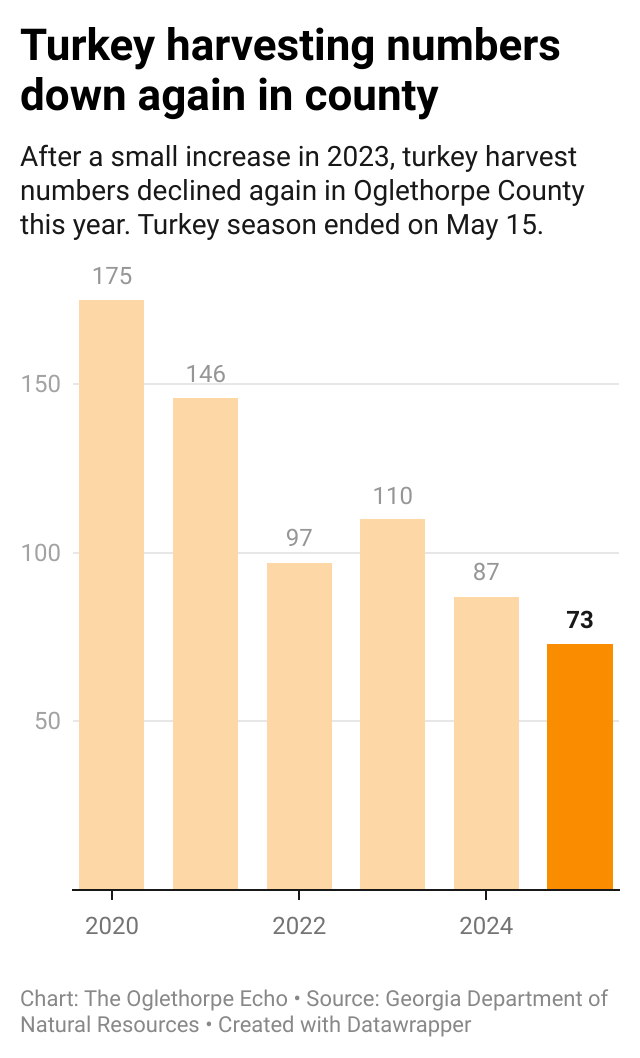
Turkey season came to a close on May 15 with a total of 73 turkeys harvested, down from 87 last spring.
Due to the declining turkey population, the state has set limitations on turkey hunting.
The season has been shortened by about two to three weeks, which could explain the lower number of turkeys harvested in recent years, Oglethorpe County game warden Phillip Nelson said.
Private land was open to turkey hunting on March 29, and public land was open on April 5. Nelson also explained that the shortened season was put into place so that turkeys have more time to breed.
“That way the hens can go ahead and get pregnant, and they can start nesting before any of the gobblers are harvested,” Nelson said.
Even with the shortened season, local outdoorsman Brandon Colquitt said the reason for the population decline is because of a lack of hens, which leads to lower reproduction rates.
The Georgia Department of Natural Resources Wildlife Resources Division reports that turkey harvest, reproduction and population rates “have seen alarming declining trends” for many years. The current poult per hen average is approximately 1.5-1.6, whereas two poults per hen is the average “break-even point for a sustainable turkey population,” according to the Georgia DNR.
Hunters also had harvest limitations. They could harvest only one turkey per day and two turkeys during the season.
Colquitt has been turkey hunting since he was 15, and this was his first season in 35 years that he didn’t harvest one in Georgia. He started to see a decline in the population around 2014 and has noticed it’s grown worse over the past decade.
He said this season has been the worst he’s experienced, and he had to travel outside the state to harvest a turkey.
“Other states are feeling it too, but not as bad as what I consider Northeast Georgia,” Colquitt said. “I feel like it is the worst in the country right now.”
Nelson said he believes that, despite recent numbers, the population might increase. He has noticed that hunters are starting to harvest more predators like raccoons, possums, foxes and bobcats, which gives turkeys a higher survival rate.
Nelson has also seen more turkeys in fields than he has in the past several years.
“It used to be in the afternoons that I could ride anywhere in Oglethorpe and wouldn’t go far, and you would see some turkeys out in the middle of a field in the afternoon,” he said. “I went a stretch of five or six years that I didn’t even see that.”
Nelson recognizes that the population and harvest rates will continue to fluctuate due to a variety of factors. Turkey hunting is less popular among hunters because it is harder due to the animals’ intelligence, according to Nelson.
“I’ve been in Oglethorpe for 23 years, and I’ve seen seasons where it looks like the population has gone up,” Nelson said. “Then I see four or five years where it’s gone down, and then all of a sudden there’s a rise.”
On the other hand, Colquitt said he believes that if things continue the way they are, turkey season will never be the same.
“I think if we lose as many turkeys in the next 10 years as (we’ve) lost in the last 10 years, there will not be a turkey season around here,” he said.