
Katie Huff is no stranger to third graders’ excitement when it comes time to learn a new handwriting skill: cursive.
“The kids always get really excited about it because they’ve just (used print) up until third grade,” she said. “It’s something they enjoy because it’s something new.”
Entering her 20th year in the school system, Huff said Oglethorpe County Elementary School has taught cursive for “a long time,” even though it wasn’t required.
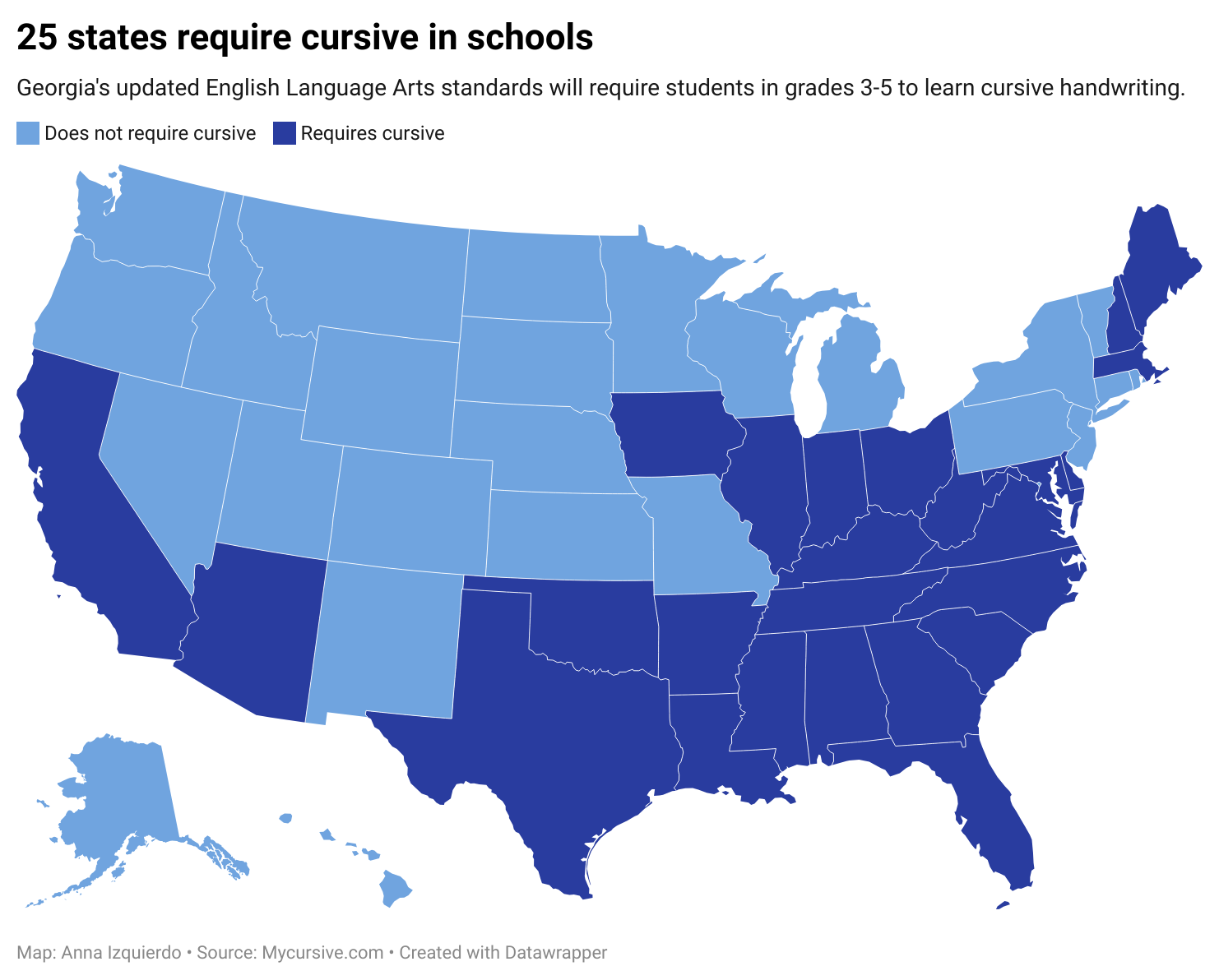
That changes this year as Georgia has adopted new English Language Arts (ELA) curriculum standards that require its schools to teach the handwriting skill to third, fourth and fifth grade students.
Georgia joins 24 other states, including Alabama, Texas and California in the cursive movement.
The enforcement of the standards are to ensure “uniformity” and “consistency” throughout the teaching of the handwriting, said Kanya Cornish, assistant superintendent.
“(The) standards are simply expectations, and so by having them, our leaders and teachers now have clarity about what is expected from all students throughout the state of Georgia,” she said.
Huff said she and other ELA teachers work during the summer and throughout the school year to develop a curriculum map to ensure all cursive standards are taught.
“It’s just a good, logical sequence of the letters and the development,” she said. “We start with the little, easier letters first, and then we do the harder ones at the end. We kind of develop them as we go.”
For three years, Huff said the school has used language training program Fundations to guide students with their cursive letters.
“It lays it out in a logical sequence for the students’ development,” she said. “And we have little videos we watch, (and) kids practice writing on their dry erase boards. We practice pencil to paper.”
Huff said teachers will initially teach students individual letters, working to connect letters and forming words and sentences.
“Sometimes cursive is easier for students to learn because it’s just a continuous writing,” she said. “With print, you stop with each letter, and the cursives are connected.”
Cornish emphasized that learning cursive handwriting also has cognitive and developmental benefits, including the activation of areas in the brain related to thinking, language and working memory. According to the Georgia Department of Education, cursive helps enhance writing fluency, supports correct spelling and is faster than writing in print.
“I believe our teachers know that, so that’s why they continue to help students to write in cursive because it will reinforce learning,” she said.
Said Huff: “It’s something we enjoy doing. And thankfully, we’ve continued doing it in Oglethorpe.”