
For Lexington resident Brandi Escoe, a parent and registered nurse, the casual appeal of e-cigarettes — or vaping — hit home through her teenage sons at school in Madison County.
“We were always hearing about it,” Escoe said. “My son himself actually had even tried it and gotten in trouble for it, and that was kind of what made me become a little bit passionate about doing more research.”
Unimpressed with disciplinary measures like in-school suspension that failed to tackle the root of nicotine addiction, Escoe made adolescent vaping the focus of her online bachelor’s capstone project at Herzing University, completing the research in December 2023.
As part of her educational outreach, she went into Oglethorpe County High School to present to a community healthcare class. When speaking directly with students, she found they completely underestimated what they were inhaling.
“They seemed to be a little bit shocked at the ingredients and the things that were put in these, like formaldehyde,” Escoe said.
Escoe said vapes pose a unique risk compared to traditional cigarettes because their discreet design allows students to use them constantly without stepping outside.
“You can just do it all day, every day,” Escoe said. “To me, that just poses more of a risk than smoking a few cigarettes a day because it’s something you can have in your hand and you can sneak and do it wherever you are.”
For school health practitioners, the challenge is overcoming the misconception that e-cigarettes are safer than cigarettes.
Kristina Turner, a registered nurse with six years in the Oglethorpe County School System, said the biggest thing they see in adolescent healthcare is that a lot of students just don't see the harm in it.
“It’s not harmless water vapor that sometimes, I think, teens like to believe that it is,” Turner said, warning that chemical aerosols in e-cigarettes can cause acute airway inflammation, coughing and shortness of breath.
School district perspective
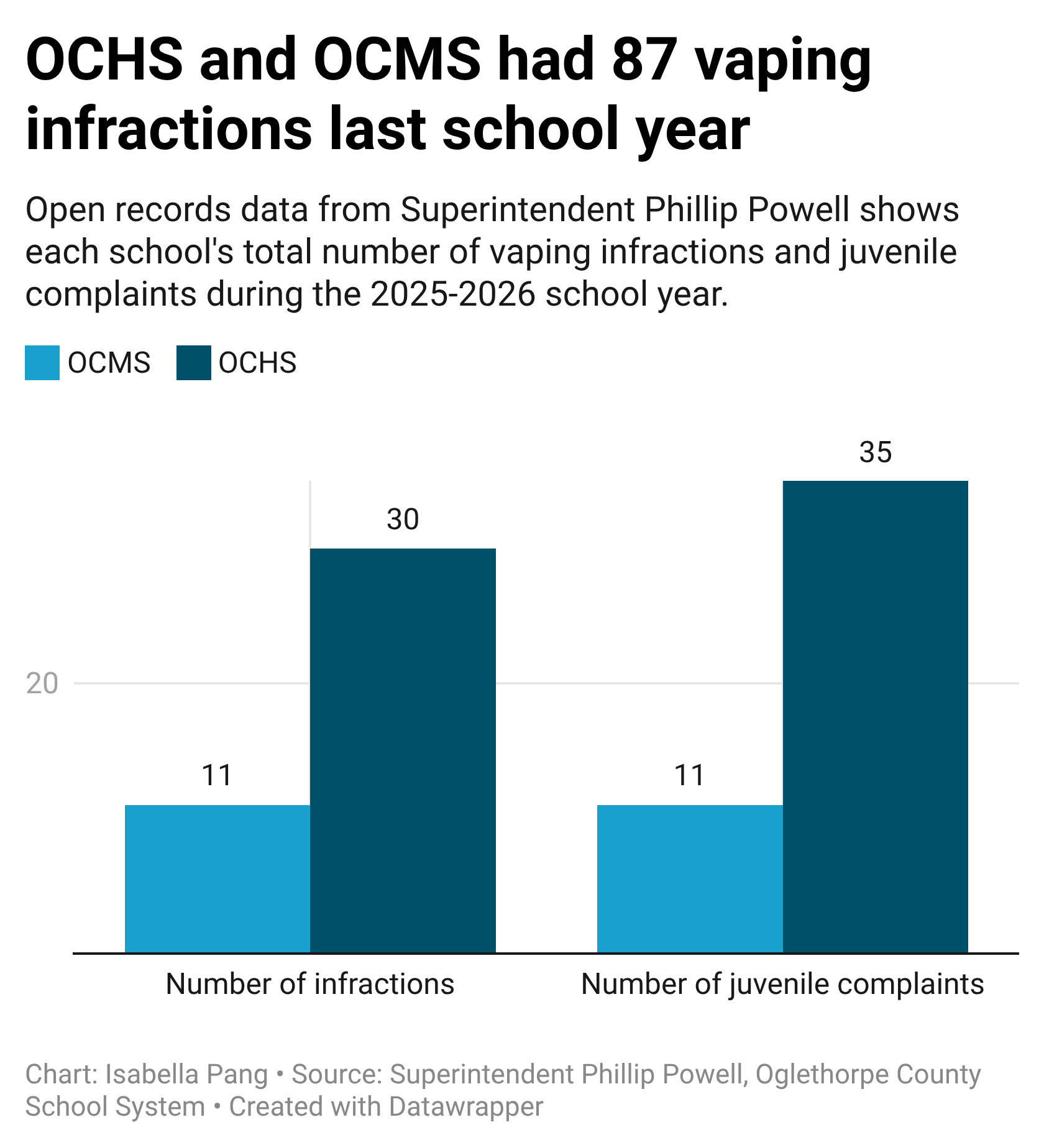
According to 2025-2026 data from Oglethorpe County Schools Superintendent Phillip Powell, there were 41 e-cigarette related infractions and 46 juvenile complaints district-wide. OCHS had 30 infractions and 35 complaints, while OCMS logged 11 of each last year.
“I think the most surprising thing is that it is within the middle schools,” Escoe said. “It is very clear that these companies are promoting them to the younger generations because that's their target audience.”
Oglethorpe County’s experience with vaping is part of a larger trend.
The 2025 FDA Annual National Youth Tobacco Survey shows that 7.2% of students use tobacco products, totaling over 2 million. High school students make up the vast majority at 9.5% (1.5 million), while middle school usage sits at 4.1% (480,000).
Under Oglethorpe County School handbook guidelines, the outcome of e-cigarette use depends heavily on the substance and the frequency of the offense:
OCHS: For first and second referrals, there is a three-day in-school suspension and ban from any area or social privileges as deemed appropriate by administration. The third, and any, subsequent referrals will result in any outcome deemed appropriate by administration ranging from 1-5 days of out-of-school suspension. Students may be placed on a behavior contract.
- OCMS: Vapes and e-cigarettes are classified as major administrative offenses. Violations involving drugs, alcohol or illicit substances can bypass the standard disciplinary step system entirely. Depending on the severity and prior disciplinary record, major infractions can lead to formal disciplinary hearings, required parent conferences, law enforcement referrals, alternative school placement or expulsion.
Balancing discipline, student support
Powell said the district aims to balance accountability with student support. It utilizes programs like Catch my Breath via Google Classroom, which allows students to reduce certain tobacco-related disciplinary actions upon completion.
The district also has maintained a partnership with Cancer Pathways.
“At a school level, it's a discipline infraction, but we also have the responsibility to support our students,” Powell said. “This is something that is unknown, and we don't know the long-term health consequences.”
Powell said Reboot, a nonprofit recovery community organization that offers smoking cessation resources, expanded to Madison County. The district can use these kinds of resources if a student seeks help confidentially through a counselor to address an addiction.
“It’s a challenge, just like any other that schools have inherited,” Powell said. “It’s got to be a comprehensive effort from home, school and society. It takes a community to kind of combat an issue like that.”